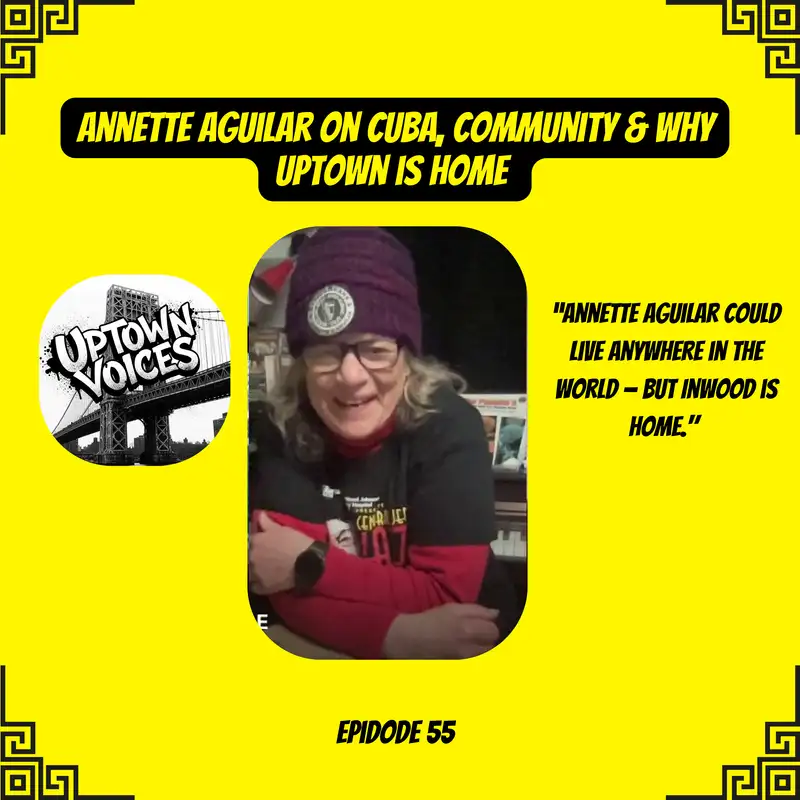
Annette Aguilar on Cuba, Community & Why Uptown is Home
Led Black (00:21)
What up, what up, what up everyone. It's Led Black and my brother Octavio Blanco for another episode of Uptown Voices. Before we even introduce our special guests, make sure you like, make sure you subscribe to the podcast. us that love, tell your people about it. That love is always helpful. It costs you nothing. Show us that love that we show you every week. But let's get to it. We have none other than Afro Latin Jazz drummer extraordinaire, my sister.
an uptown fixture on the music scene, Anet Aguilar. Anet, how you doing sis? How's it going?
Annette A Aguilar (00:55)
I'm good, Papi. Good to see you guys. You guys look good. Not that you look bad before.
Led Black (00:58)
Thank you, thank you, likewise.
Octavio Blanco (00:58)
You
Led Black (00:59)
Thank you, thank you, thank you. Thank you. Octavia, how you doing, brother? You feeling good?
Octavio Blanco (01:05)
I'm feeling good. I'm excited about this ⁓ about this episode me and Annette go way back. We've shared many, many, many, many fun times. Annette has played at a few at one of my events when I was president of NAHJ one of our, our, our annual bashes she and her quartet or trio that was there ⁓ played all night for us. And we had a good time, good time dancing to the
to her music. Annette, I'm so glad that you're here. How you doing? How's your day been? Led, how are you doing?
Led Black (01:37)
likewise.
I'm doing good. Do excited for Annette, like Annette, you I know you stay all over performing, traveling, you know, so just want to thank you for being on the show and tell us how you feeling, how's it going?
Annette A Aguilar (01:52)
feel good, know, it's a pretty busy day today. You know, it's been busy. It's just ever since the, ever since Three Kings Day. Playing in Museo de Barrio, freezing our asses off. Yeah, I like to, you know, I mean, the band played on the float up there in the Museo de Barrio. And then, you know, I teach all over, but one of the schools I
Led Black (02:03)
Right, Early January, you stay busy, you stay working. God bless.
Octavio Blanco (02:03)
Hey
You
stay busy.
Annette A Aguilar (02:22)
been teaching for a long time is Celia Cruz Bronx High School of Music. know, it's like the school, over the last 20 years I've been there. I'm like the percussion teacher coming once, twice a week, pretty faithful. And today my, and it's like the look, it's like the LaGuardia in the Bronx that happened. And it's really good for our black and brown kids to have that kind of schooling up there and just, just people in the Bronx too. Not just, you know, it's not exclusive, but that's
the Bronx, I don't have to tell you about the South Bronx and the Bronx. And today my kids did really good at their adjudications. They did excellent and outstanding, so I was very happy. yeah, it's been quite busy,
Octavio Blanco (02:59)
you stay busy and you're like so energetic. Not only are you busy and energized because you're performing in all these places, you're also teaching, but also like, you you're a runner, you've got a high energy, plus the instrument that you...
the percussion is not exactly a low energy kind of instrument, you know? So how do you do it? How do you stay so energized?
Led Black (03:23)
Right, right.
Annette A Aguilar (03:28)
⁓ well...
love what I do, you know, it's work. We love what we do. Like you love what you do, but it's work. Like when you did that thing in Midtown, when we played, you know it was a pain in the ass. By the way, what kind of words I can't say? Tell me, what's the
Octavio Blanco (03:38)
Yeah.
You
Led Black (03:47)
Any words you want,
Octavio Blanco (03:47)
No, you
say whatever you want. You say anything. We're good.
Led Black (03:47)
we're good. Yeah, Octavia has a foul mouth, not me, but Octavia has a foul mouth, so.
Annette A Aguilar (03:49)
Okay, so one.
Octavio Blanco (03:52)
Yo, yeah, right, yeah, right.
Annette A Aguilar (03:53)
I
love what I do, there's, you know, I just, mean, I do teach, you I do the math. I've done a lot in my career for sustainability. I educated myself and, you know, I got two masters. I don't know if you know this, but I got two masters. I got one from the conservatory, Manhattan School Music when I first came to New York in the mid-80s.
in Washington Heights, okay, mid eighties, when it was burning. I saw everything. I see you, but I, I saw that, you know, I was there, there on 155th street, going to grad school from San Francisco. I wanted to come to New York. And I remember my partner at the time when I walked up to Broadway.
Led Black (04:17)
Wow.
That's for real, wide sides. Right.
Yeah
Annette A Aguilar (04:43)
It was a mess up there because you know Saint Nicholas was forming the formation of the crack that was happening in the Heights. It was. I don't know whatever you want to say. I mean, there's a lot of good things, bad things, but that was happening during that time.
Led Black (04:50)
Mm-hmm. Yeah. Mm-hmm.
Yeah,
the lower heights were the epicenter of crack at the beginning.
Annette A Aguilar (05:01)
Yeah,
yeah. And I was like, me, you want to go back to San Francisco? I go, I came here. I'm at the grad school. I didn't want to go. mean, San Francisco is a beautiful city. And it's interesting because I remember leaving and saying bye to my mother. And, my sister just had a baby, which was my niece, and that kind of kept my mother busy. So I could tell, you know, my mother was a bit sad, you know.
We just, I didn't know, but I just recently, we just recently lost our mother in December. So, yeah. You know, whatever age they do, they go. It's just, it's a different, it's a different situation. However, she was a force of nature. I, when I, you know, she raised six kids by herself, barely speaking the language. My mother was from Nicaragua. And so was my father. You know, everybody thinks, you know, we say, say, I mean, I think you understand Octavia.
Led Black (05:33)
Sorry to hear that.
Octavio Blanco (05:34)
Sorry to hear that.
Led Black (05:54)
I got a tool.
Octavio Blanco (05:54)
Yeah, same
thing in Mexico.
Annette A Aguilar (05:56)
I don't know if the Dominican say huela. That's a Mexican.
Led Black (05:58)
We don't say that. We
don't say that, but I know what it means. Yeah, yeah.
Annette A Aguilar (06:01)
That was a buggy.
Octavio Blanco (06:02)
Is it
trigueñita in Dominican? Trigueña?
Led Black (06:06)
No, puerita means white though, so triguerita means dark skin. Yeah, yeah, triguerita means dark.
Annette A Aguilar (06:08)
Yeah.
Octavio Blanco (06:08)
⁓
Annette A Aguilar (06:12)
the weather and,
Led Black (06:14)
Yeah.
Annette A Aguilar (06:15)
and that's so, my mother worked very hard and she also like, she first worked at Levi Strauss and then she got a job at the city in San Francisco. She worked in the district where Harvey Milk was. He met Harvey Milk. was, that's her friend. And she worked for the health department for 30 years.
Octavio Blanco (06:31)
Ugh.
Led Black (06:34)
Wow.
Annette A Aguilar (06:38)
And that's when he became, you know, ⁓ well, she's got the gig in the late sixties and he came in in the seventies and it was a safe haven for me to be in the cast. was Castro, know, Castro, San Francisco. And my mother said, don't worry. You come eat me for lunch. Nobody, no one's going to bother you. And she was right. Of course, not to do friend, my friends, the people from the mission, but not in the mission.
Led Black (06:49)
night.
Octavio Blanco (06:59)
Ha
Annette A Aguilar (07:07)
Turn that time!
Octavio Blanco (07:08)
For those of you who don't know about the Castro district, it's LGBTQ friendly, let's say.
Annette A Aguilar (07:17)
Yeah. And,
so the workforce really came from her because she always, she worked 30 years, worked for the Levi's sprawls and she worked 30 years for San Francisco. When she retired, she got a proclamation for Willie Brown, then the mayor then for called Argentina Aguilar. By the way, my middle name means Argentina. It's my mother's name. And my mother's not from Argentina. Yeah. So he never, ⁓ she didn't call in sick. That just didn't exist.
Octavio Blanco (07:39)
⁓ wow.
Annette A Aguilar (07:46)
only if she had like surgery or something really important. She went to work. That's why, you know, for me, I'm kind of like, if I'm like complaining about something, I think about her, I think about my Abuelita, you know, I think about how hard they work. was, you know, your parents, your grandparents, there was nothing about bullshit. You fucking showed up. He says somebody has a headache and it's like, unless it's a migraine.
Led Black (08:07)
Yeah, you showed up, yeah.
Annette A Aguilar (08:14)
But you know, somebody has a headache, it's all Noah, I gotta see my therapist. I'm
Octavio Blanco (08:18)
So.
Led Black (08:20)
So the workout that comes from your mom, Annette, where does the drumming, where does the love of music come from?
Annette A Aguilar (08:23)
Yeah.
The music comes from, well, growing up in San Francisco, we were in like, there's the mission in Noe Valley and it's like, Noe Valley was like, I mean, it was a working class neighborhood where Irish, Italian, Latinos were buying houses, okay, but they were working classes. And they were able to, I mean, if you had a little bit of money, save, you know, whatever, you can buy something. You don't have to be a freaking, you know, work for Silicon Valley.
I'm
Led Black (08:58)
Right, right.
Annette A Aguilar (09:00)
And then the mission was right there. It's just a block, two blocks. It's like the heights and then you got the mission, know, got the Inwood Sight of Family Stone, Grateful Dead, Jefferson Airplane, all come from San Francisco. Okay, I like the Beatles. Then, you know, of course my mother was Latino, in the Boleros and all that stuff. Then Carlos Santana came out and that was in the mission.
Led Black (09:07)
Bye.
Annette A Aguilar (09:28)
And that was Latin rock. And also, my guy, where is he?
No offense to Mr. Mambo, who I had a chance to play with Tito Puente, but anybody who popularized internationally the music was Santana. Sorry. Because Oyo Como Va was written by Puente, who had made famous, and Puente really liked that Santana played Oyo Como Va. Made him a rich man. So, well, I don't know rich, but well, whatever. We don't know. Oyo Como Va, Santana played it, and that was by Puente.
Led Black (09:58)
Yeah.
Octavio Blanco (09:58)
Probably
did.
Led Black (10:02)
Yeah.
Annette A Aguilar (10:03)
So that was happening. And we had a park called Dolores Park and people play drums. And I started playing drums first and it was part of the community. It was a community situation and people love music. They get together, they have dances at the Catholic schools, have workshops. And it was just something that, you know, lot of my friends would go to that workshop they played.
One guy named Carl Paraza who's played with Santana for 38 years, not 30, 30 years. I met him when he was like 10 and we were 10, we were playing. And he became Santana's percussionist. just, and playing music. So that's really what that came from. But one thing it turns to.
Led Black (10:43)
And
how did it become Afro Latin Jazz? Like how did you find that path?
Annette A Aguilar (10:48)
Well, thank you. Very good question. Well, this is interesting. We were doing, we started the Santana Latin stuff and people started going into the Latin music and then started studying, doing research, you know, and then, and then, you know, the salsa era broke out in San Francisco. Willie Colon came to San Francisco in the mid 70s and everybody went to that concert.
So all the New York people, Fania All-Stars, Willie Colon, and then my brother had a band called Típica Sen Fuegos, a guy, a brother of mine named, a brother by soul, John Santos, started a band called Típica Sen Fuegos and started studying the Afro-Cuban stuff. We really started learning that it was Cuban music, of course. It's Cuban music. And, you know, and...
Led Black (11:38)
Right, that's right.
Annette A Aguilar (11:43)
But Johnny Pacheco, of course Dominican Johnny Pacheco, Fania embracing because of the embargo and what was going on, started the whole thing of the marketing of salsa. I then you study more later in the 40s, in the 30s, in the 40s, Son Cubano, you study about Chico O'Farrill, you study about Mario Baza, Machito. I mean, those guys, Mario Baza coming here in the 40s, and he come here for the winter. They come here.
They came here from Cuba, he came here, to the jazz that was happening here. So the study of the Afro-Cuban came more to the root of it because I'm a drummer. I got to know where this comes from. Yoruba, West African, the people of Yoruba. And then we started all studying this stuff because everybody in San Francisco started studying the people that I was with and how embrace New York was because of all these great bands. Of course, Ifania.
Led Black (12:29)
Mm-hmm.
Annette A Aguilar (12:41)
I mean, we love Pacheco, we loved, you know, Celia Cruz, and all the people from New York, and people forget how many, the combination of people that were in that band, of course more Puerto Rican, but Pacheco's Dominican, Mario Rivera, who played with Puente was Dominican. And then you have Puerto Ricans and the Jews, a long time player, know, Larry Harlow was part of Fania. And then so was Louis Kahn, who was a Jewish.
Led Black (13:05)
Bye.
Annette A Aguilar (13:07)
because a lot of the Latin music came up to the Catskills and the Jewish people really embraced it. That's very interesting. So I wanted to study and a lot of people don't understand that a lot of the Cubans all went to the conservatory and studied classical music. yeah, charanga, strings, flute.
Led Black (13:27)
Wow, isn't that nice?
Annette A Aguilar (13:34)
A lot of the musicians today like Elio Verede Franca, Omar Sosa, they all went to the conservatory. And because, you I was just in Cuba in January, it was my second trip. This year was kind of hard because we had to like, you know, because the shit that happened in Venezuela and we didn't know.
Led Black (13:51)
Mm-hmm. The siege, the
siege that America's doing on Cuba unlawfully right now, yeah.
Octavio Blanco (13:58)
Yeah.
Annette A Aguilar (13:59)
Look, man, you know, it's like, why don't people just let people live? Just let them live their life. You know, let them have a nice place to live, you know, have food, you know, have a vehicle, a bicycle. Why do we have fuck with everybody?
Led Black (14:07)
Yeah.
Yeah.
Yeah, and I don't mean to veer, but Trump said the other day, he's like, we can free it, we can take it, we can do whatever we want. This is sovereign people, it's just so messed up. And I think we don't talk about Cuba enough and what's being done, but I'm glad you were able to go because I think it would be a big loss to have America just take that country over.
Octavio Blanco (14:38)
Yeah, and I want to just say one thing about Mexico. They've been delivering, they've been going through the embargo, and they've been delivering aid. So big up to Claudia Scheinbaum in Mexico for doing that, for sending that aid, but it's not enough. Cuba is struggling right now. But ⁓ yeah, it's terrible. I don't want to veer too far into the...
Annette A Aguilar (14:45)
Yeah.
No.
Octavio Blanco (15:03)
public affairs policy stuff about Cuba, because this is about you and it and I know that that's important. And I know that that's, you know, that that trip was important. So like, tell me about your trip. And beyond the the difficulty that people are experiencing, you say you've been in Cuba twice now. What's it like to be there?
considering that people are suffering, but I do feel that Cubans have resilience. Do you see that on the streets? Do you see people playing their music?
Annette A Aguilar (15:32)
I think, you know,
there's a lot of people playing their music and I mean, I mean, it's my second trip. You know, I with Arturo O'Farril because I've been working with him with Bronx Banda for the last six years with Casita Maria. And I've gotten close with him musically and, you know, both of his parents are buried there. Chico O'Farril is buried there and we went to the gravesite last year and very emotional for him.
Led Black (15:54)
Wow.
Wow,
I could imagine.
Annette A Aguilar (16:02)
I
look, I just lost my mother and, know, we just did a gig, did with Bronx Banda with the Afro Latin Jazz Orchestra, just did a gig in Moseo. And, you know, I just got home from my celebration of life with my mother and we were rehearsing and Tura looked at me, he goes, you know, you look sad. go, you know, and he came and gave a hug. says, mother's loss is not always the same. So he was very sad going to the cemetery last year. I went there with La Bruja, came, Caridad was on that trip. A lot of great educators were on that trip.
And it was a little bit lighter last year because right before Humpty got in, you know, and, this year we had to have some precautions if we had to like get out, either go Panama or Canada or whatever the thick was going to happen. still, it was, I wanted to go, but we went anyway. We went.
Led Black (16:35)
Bye.
Annette A Aguilar (16:55)
They're very resilient. We played the Havana Jazz Festival. It the second time I was invited to play or participate with Arturo. The musicians, a string quartet, a dance company, a young, youthful, beautiful, black Cubans, mixed, know, and amazing musicians and the festival. There was a lot of blackouts. And I know one time we had to wait about an hour or two for our car to come because you couldn't get gas.
You know, and just, I feel very safe there. You know, it's very, you know, I've been, you know, look at, I've been to Rio Rio is not safe in certain places, unless you're with, but Cuba, I mean, there were some people who had some things and see people who don't and people who are talking about, who are in business and were concerned about certain things that they can't get. I mean, we went.
We bring stuff. Like I bring a lot of materials, like medical stuff. And then we go to a school that used to be a golf course before, after, you know, Batista. It was just a golf course for, you know, people, know, there's nothing like, if you have extra money, fine, but don't be a pig. You know, the golf course now is a music school.
And it's beautiful. I don't see anything wrong with that. You know, I mean, look, you can have a golf course here, but you don't have to have many of them. My brother plays golf. You know, but it's just like, you know what mean? I mean...
Led Black (18:28)
Right. Yeah, yeah, it's not
golf per se. It's what it represents, right? Yeah.
Annette A Aguilar (18:35)
You don't have to have 50 golf courses at one f***ing corner place. Have one here, one there, you know, get a ration. I mean just measure it out. And that Cuban music, I've been studying it for a long time and a lot of my friends have gone there for many many years. They're the source that made that habanera go all the way around the world.
Octavio Blanco (18:48)
No, I feel you. feel you.
Annette A Aguilar (19:03)
Cuban son
Led Black (19:06)
Yeah.
Annette A Aguilar (19:07)
I mean everybody has different stuff. know, Dominicans have marangue, they palo, you know, and they have bachata But the bachata via the bolero. You know, and then you have the Puerto Ricans who have bomba, bomba is kick ass. You know, a bomba that you find that rhythm in Brazil like my own. ⁓
Led Black (19:16)
Bye.
Annette A Aguilar (19:33)
⁓ And then the plena. You know, I know I move around here a lot, but you know, I love, I've loved Bad Bunny for the last four years, whatever. I mean, I love him. And I get these jazz musicians, you know, getting on my ass about it. Now screw yourself, man. Who plays plena in the beginning of the Grammy? The traditional plena.
Led Black (19:57)
Hahaha
Annette A Aguilar (20:02)
What do mean Blenna? What do mean you're playing Blenna? It's a fucking Puerto Rican rhythm from Puerto Rico. You know, I don't see, you know, I mean, what are you gonna dogbuck Bunny about? I mean, really. I mean, this was a couple of years ago when he was on the Grammys doing that. And he's just like, you know, these are people. I just want, you know, too much.
Led Black (20:10)
like
Octavio Blanco (20:25)
Well, you know, that's one thing about you, Annette, that I love is that you're so down to earth. You know, you are obviously like one of the most highly educated people out there in terms of the music that you play and the music that you know. mean, people may not understand just like your status, but I mean, you've traveled the world, like around the world with this music. So it's not like nobody really, it's not just like anybody can do that. So that's one thing.
But at the same time, you're such a community person. We see you playing at the local restaurants and I don't know that, and we see you playing at the local festivals. And I don't know that people really realize what a treat it is that they're getting when they have you.
The one question that comes up in terms of like, where's the wildest place that you've ever traveled to with your music? mean, was it Asia? it a?
Annette A Aguilar (21:24)
dangerous
We were in Rwanda.
Octavio Blanco (21:33)
wow.
Rwanda.
Annette A Aguilar (21:37)
Yeah, I stayed at the Wawanda Hotel.
Led Black (21:40)
wow, with a massacre happening.
Annette A Aguilar (21:42)
Yeah, but we were there during that time. I mean, this was 2000 and.
2003. This is one thing I have a butt in my ass about the Kennedy Center, okay, because I love the Kennedy Center.
Led Black (21:53)
The Trump
Center, get it right, and that is the Trump Center. ⁓ Our president needs to be respected, okay?
Octavio Blanco (21:56)
Hahaha.
Annette A Aguilar (22:00)
This makes me feel like I'm swearing
in the view. The fuck center. I shouldn't say that. I have all my kids listen to me. I shouldn't be swearing like that. I usually don't swear on social media or anything. But I feel like sometimes, no, because Billy Taylor, Dr. Billy Taylor, who started Jazzmobile and the education thing, he was the artistic director of the Kennedy Center.
Led Black (22:16)
It's okay.
Annette A Aguilar (22:32)
And I met him through the late Stanley Cowell when I was playing up in, you know, was up at Lehman College. And he got a hold of Billy Taylor too, get a hold of me. And he told me, Billy Taylor has a, the Mary Lou Williams Women in Jazz Festival. You got to submit the CD to, this is my first CD. This is a good CD. It was the first one? Yeah. And that's how, and I did, and I was invited in 2001 to play at the Kennedy Center.
with the Mary Lou Williams Jazz Festival. And who was playing that time was Cindy Blackman was playing before she was Cindy Fentana. A lot of people were playing. Maria Schneider was, know, the time I went back again, met Esperanza Spalding. She was playing, Annette Cohen, all these great Janet Siegel from Manhattan Voices. The Manhattan was a metronome. And but Dr. Billy Taylor had the Latin Jazz Ambassador.
They used to be jazz ambassador because you back in the day they called it the good nature or goodwill thing. They travel you know so he, goodwill ambassador. was a lot of people, Louis Armstrong did that. I know Charlie Bird did that. He went there. He went to Brazil and turned Stan Getz on to the bossa nova, to Brazilian music. He didn't give him credit too much for that.
Octavio Blanco (23:39)
yeah, goodwill ambassador.
Annette A Aguilar (23:55)
But Billy Tater loved Afro-Cuban music and he wanted to have a Latin Jazz ambassador thing. So 2001 I played and then in 2002 this whole audition thing happened. I didn't even know about it because I was trying to record for my second album and I go where are the musicians at this date? They're busy. They're busy doing what?
They're auditioning for the Latin Jazz Ambassadors for the Kennedy Center. Why didn't I know about it? Because nobody wanted to tell you. So, but a friend of mine told me. And then I emailed them and they invited me to go to audition. Forget about the paperwork. I was invited and I did some hard work with this quartet. This was 2002, October. And we got in. It was about, we beat like 150 quartets of application and then 50 who auditioned, we got in.
We did the music. we went to South Africa, went to Swaziland, where I met the American ambassador, African-American guy. I'm still friends with him. Swaziland, remember in Swaziland during that time, I don't, let's call something else now. It's not Swaziland.
Octavio Blanco (25:03)
Is it
rhodesia? that what it is? ⁓
Annette A Aguilar (25:05)
No, no, it's not a feature, it's another name.
Led Black (25:05)
No.
Annette A Aguilar (25:10)
Well, was Swaziland. I still had the flag. Anyway, we went there where Swaziland, a woman was not allowed to travel without the consent of her husband. ⁓ you can't be gay. You can't have same sex person relationship. But we were there, you know. I was. They kicked me out when I was with the embassy. And then, so.
We went there, we went to Namibia, Botswana, we went to Shwakamon, which is the far west, went up to somewhere else, and the last trip was in Rwanda. And we were at a school. We went over, had one, it was really interesting, we were at a school, and the director there invited me to stay, me, to work there for six months. And I'm like, I think I'm going back to Inwood.
Octavio Blanco (26:02)
Hahaha
Annette A Aguilar (26:06)
It's okay. But that was interesting. Being in Rwanda.
Led Black (26:12)
⁓
And then you got a big Mother's Day. I'm sorry.
Octavio Blanco (26:14)
How long were you in Africa for? No, it's okay. How long were you in Africa for for that whole time? And by the way, Swaziland is not known as the kingdom of East Swatini.
Annette A Aguilar (26:22)
We were there for-
Led Black (26:28)
Eswatini, yeah. I how you Google that like you knew it. Don't pretend like you knew that. OK, please. ⁓ by the way, it's the kingdom of Eswatini. Like that's Google. ⁓ I did the same thing.
Octavio Blanco (26:29)
S. What teeny
I was looking, I googled it, yeah.
Yes, it is.
Annette A Aguilar (26:45)
That was a six week tour, that first tour, a month, six weeks. And then I came back and what was really good, because I was teaching in the South Bronx at the time and I had a great principal. Even though I got with the school, second masters, get certified, do all that crap, I didn't want to, I liked DOE, but I didn't want a full time thing because I didn't want to like held hostage.
So I taught in the South Bronx, which was three, three and a half day, four. I had some, you know, I got benefits and stuff like that, but she would let me, this principal will let me take off, get a sub. That wouldn't happen in DOE if I had a full time something. and, and so yeah, I was going there for six weeks. And then.
Octavio Blanco (27:35)
And
wait, I was gonna ask you something real quick before we move on. You move so fast. I need to rein you in a little bit to ask you some questions because the music, as we said, is Afro-Latino. And so you're in Africa playing Afro-Latino music to Africans, Latin jazz. So what was the reaction to the music?
Annette A Aguilar (27:41)
Sorry.
Lenten. We call it Lenten Jazz.
Octavio Blanco (28:04)
by the African, especially the youth, who maybe hadn't heard Latin jazz before. they're hearing, maybe sometimes they might even be hearing their own music being played back to them in a different way. What was that like?
Annette A Aguilar (28:18)
Yeah,
they were very responsive. When I was in Namibia, I went to school and taught them the picadillo tito puente on the marimbas, playing tumbaus and rhythms. And it's just something different. You know, it's like something that was created because Latin jazz was created here in New York City. I mean, it's Cuban. But if, you know, with these compositions like tanga from Machito Mario Balza,
were the first things of Latin jazz because jazz is you know America's it's a black African-American art form blues you know so that happened here didn't happen but the clave is from Africa and coming to Cuba coming to New Orleans and you know of course unfortunately the enslaved Africans brought that rhythm but the
the combination of the blues, the European harmony, well, jazz harmonies and European things, because that's influenced in the conservatory. mean, like Bach, you know, he's an improviser. So I'm trying to, you know, so they could understand that because I had a great piano player with me on one of the second trips and he would teach them jazz chords. And some of them were familiar with that. We would do workshops and we'd talk about Puente, we'd talk about the Brazilian samba.
certain composers that have because America, United States is so responsible for a lot of great music. know, James Brown, hip hop, South Bronx, that didn't happen in Brazil. Didn't happen in Cuba. It happened here. And I, you sometimes I'm going to have to say this.
Led Black (29:58)
Mm Right.
Annette A Aguilar (30:05)
And I'm going to say it. Sometimes there are some gringos who start talking about how there's no groove here and this music comes from over there. Okay, go tell that to James Brown.
Led Black (30:21)
Mm-hmm. Right, no, you're right.
Annette A Aguilar (30:23)
They like this
music from here. This is jazz. Jazz. Duke Ellington. know, Wynton Marsalis Whether you like him or not. You know, I like him.
Led Black (30:29)
Bye.
Right, and Dizzy Gillespie,
right? Dizzy Gillespie brought in Chano Pozo who changed, right, so yeah.
Annette A Aguilar (30:39)
And then Dizzy Gillespie with Chano Pozo, Chano Pozo being a black Cuban who was in the Albuquerque society. I mean, he was a little rough, you But then there was other people before them, Candido, Patato, you know? And then the women, Mary Lou Williams, a black woman in Harlem, taught a lot of these people. She taught monk.
All the jazz musicians were going to her apartment and studying with her. That's why Billy Taylor started the women, the Mary Lou Williams Women in Jazz Festival. I mean, if you saw what's going on right now, you'll roll over his frikkin grave
Led Black (31:08)
Wow.
Octavio Blanco (31:22)
I love this about you and that you're not only an excellent practitioner, but you're just like a font of information and history. Really, it's really incredible. Are you, I mean, this is an honest question. Are you planning or have you ever considered writing a book or anything like that?
Annette A Aguilar (31:43)
I'm trying to get more disciplined. No, am disciplined. Yeah, I thought about that. I have a lot of young friends who were telling me, know, lot of young scholars, they're college, they're late 20s, early 30s, they're very bright. And I said, know what saying, man, I think you should start shutting this stuff down, you know, which is, I'm thinking about it, you know, I'm thinking about...
I like to practice and like to study, you know, and I like to learn from people. There's so much to learn out there. I have that. But yeah, possibly. Yes. I think I need to just start writing, you know, and you know how everything is. You guys are busy. Led, you're busy. Poppy, Octavia, you know, I've been practicing, trying to utilize my time in the best way I can on the meditation of practicing, taking care of my body. Cause I run with the Dyckman Run Club.
Octavio Blanco (32:14)
Yeah.
Yeah.
Annette A Aguilar (32:37)
But last year I had two injuries and a lot of the guys on the club, the guys and girls, most of the guys had injuries after the marathon and couldn't run. But there's other kinds of exercise, bike, walk. I do a lot of weights because women need to do weights because our bones are different than guys. I mean, look it, I like to go out and have my cervecita or whatever, but I'm not gonna be there all night.
Octavio Blanco (33:06)
Those days are over.
Annette A Aguilar (33:06)
You know, I want to
get up and have a cup of coffee, you know.
Octavio Blanco (33:13)
We're not closing
down the bar. We're not getting locked in anymore. A Piper's kilt.
Annette A Aguilar (33:16)
Not every night, you know, I mean,
remember the Piper's Kilt? I remember when I used to go to the Piper's Kilt in the early days, because that was the best place to get the burger in the early 90s. You know, and you look at, I grew up eating fijoles, so I don't need to go eat fijoles, you know, beans or rice. And by the way, I I liked, I love Dominican chicken. I liked the yuca and the yuca was really good for me because it was good for the marathon. So I would eat Dominican yuca with
Led Black (33:18)
What's in a while?
Octavio Blanco (33:22)
It was a great place.
Annette A Aguilar (33:44)
Eggs for marathon thing, but you know the habichuelas a little bit too many gravy for me I need beans so anyway, we used to go down to Piper's kilp and I remember man all the Irish Guys in there. I mean those guys would like they were like the living dead sitting at the bar I don't want to get notes like I'm
Octavio Blanco (34:05)
Some of them were some of them get into the
It was a great place. Shout out to Tommy and Scotty and Fred and Mike, all those guys, Katie.
Annette A Aguilar (34:16)
No, I mean, I mean, they're Irish. ⁓
Mike man, what the hell is this? I can't believe this is happening man. I tell
you, let's get real. Katie, turn around that place man. You know, you and I had this conversation about it because we're going to talk about the closety Inwood
It was a closet case. I remember, I mean, when I was touring a lot, I would have, I could talk about this now, cause I'm like, you know, I'm good. I meet a lot of different people from, I had a lot of different girlfriends from different places, know, Toronto, West Coast, whatever. I mean, I was, you know, I wasn't like cheating or anything like that, but whatever. they will come here and come and visit me.
And they want to walk down the block and hold hands. No, no, we can't do that here. What? We have to wait to go to the village. This is closets. We're not in San Francisco, hon.
Led Black (35:19)
Yeah.
is different.
Annette A Aguilar (35:29)
It was the closet hang. And not until Katie, if anybody who brought out anybody out in the neighborhood and brought the gays to the Piper's kit was Katie. Hey, everyone. What's up?
Octavio Blanco (35:41)
made them feel safe.
Made them feel safe and welcome.
Annette A Aguilar (35:46)
And still safe. She created a safe ground for a lot of people. She didn't even know what she was doing. She did know what she was doing, but she opened that up. She turned that place around.
Octavio Blanco (35:57)
It was just natural for her to do that. So how has that changed? Is it less so? Is it more accepted now? Is it still very, very taboo or is it not quite as taboo?
Annette A Aguilar (36:10)
it's changed, thank God.
You know, it's changed. The last... I'm talking 90s. know, the 90s is over 30 years ago. Jesus. It started to change.
Octavio Blanco (36:20)
Yeah.
Annette A Aguilar (36:25)
I would say 20 years ago and then it got better 10 years ago. You know, cause I remember I would see some guys walking down the block on Dyckman and I see cool. But now places like Tryon is the most out place. Tryon is, they have the most diverse crowd. They have like, you know, the Dominicans they have everybody going into Tryon.
Octavio Blanco (36:45)
Mm. Mm.
Annette A Aguilar (36:53)
You know, I'm looking, Niall's not paying for me this. But he needs to have the band back in there anyway, Niall. But,
Led Black (36:59)
You
Annette A Aguilar (37:03)
No, but it's better. It's a lot better. mean, you know, I guess 20 years ago, but it was rough back then.
Octavio Blanco (37:11)
You know, something
that I just learned, I met somebody in the Jewish community and they told me that this neighborhood, if you are an Orthodox Jew, and you're also LGBTQ or queer, that this neighborhood is like the one place in America where queer, gay Jews feel safe and feel welcome.
Isn't that wild? I never knew that. So, yeah. So there you go. It looks like it's changing ⁓ everywhere. Annette, so.
Annette A Aguilar (37:38)
Wow. I didn't do that either, but...
Led Black (37:39)
Never knew that.
Octavio Blanco (37:50)
you're involved in jazz, you're in jazz educator, but there's a lot of jazz in the neighborhood. There's like jazz, wahey and all this, all these things that are sort of like jazz. Jazz is like the, the happening thing right now. Are you also involved in all that stuff? Like the, the jazz wahey movement and all the jazz festival that comes up town? Are you, have you been, have you been, are you part of that movement as well?
Annette A Aguilar (38:17)
Well, the movement I've always been part of is with Eli Yehman. He's an old friend and I met him at Stas Power. Now he is a bebopper. He studied with Barry Harris. He's a BAB MF. Okay. He knows, he knows his stuff. I mean, he knows how to play. Okay. I'm just talking about him. I could talk about other people because they're friends of mine.
Led Black (38:23)
Jazz power initiative,
Octavio Blanco (38:36)
You
Annette A Aguilar (38:45)
But I met Eli and I started doing stuff up here because I wanted stuff because I learned that from the Brazilians and the Cubans to have community. I learned that in my community that you have music. I mean, they were even doing it downtown in Guantanamara when it was Azucar Pedrito Martinez, and they were playing by the window and made that place. And the same thing up here. mean, Garden Cafe used to have that when, you know, they were doing that myself. But I'm involved with Jazz Power because he does education for kids.
His thing is about educating youth. These are the places, mean, love, Joshua had, they're great. They started, you know, not as long as Eliza, but they're good people, but then the Heights. And they do a lot of good things. And then Aaron Scott,
He's an African American, nice guy. And I played the first Inwood Jazz Festival with him in his festival 2003. No, oh shit, 2023. He played with McCoy Tyner for 15 years. So, and he brought a lot of the black jazz musicians up here, which I like seeing that, you know, because a lot of people, you have to give homage to the black jazz musicians, you know, and a lot of
Led Black (39:53)
Thanks
Annette A Aguilar (40:03)
I mean, know, there's a lot of, it's always been a lot of racist stuff with things. Even, you know, there were certain band leaders back in the day that they, that the producers would say, you can come, but don't bring your black musicians. That happened to Puente many times, you know, but one thing that happened in the West coast was Cal Jader. From San Francisco, gringo on the vibes, Mongo Santa Maria, black Puerto Rican, Willie Bobo.
black African-American Al McKibbin playing bass. Vince Giraldi did all the music for Charles Swoops. That sextet playing in North Beach of San Francisco was the West Coast Latin Jazz. And they would play for, what was that guy who was Paul Hugh Hefner? The Playboy guy?
Led Black (40:47)
Yeah,
Octavio Blanco (40:47)
Yeah,
yeah.
Led Black (40:48)
the Playboy, yeah, Hugh Hefner, yeah.
Annette A Aguilar (40:50)
the Playboy guy there's a video on YouTube this is the late 50s might be 60s that Jader's playing the real out the vice and all black band at because it's San Francisco it's California it has and they're like all the people listening and the black people sitting next to some you know do a Barbie doll looking white girl and just like they're swinging it
But sometimes some of the places you couldn't even fit in, you know, marry a black woman or a black man. Is that crazy? You know, it's such a control shit. Now who's marrying us? You or me? It's a trans thing. Who's being trans? You or me? Well, relax. If I'm a vegan, you don't have to eat vegan. Go after Chicharone.
Led Black (41:24)
Bye.
Touch bullshit. Yeah, And then, then that.
Yeah, exactly, your business, right?
Octavio Blanco (41:38)
Mind your business, exactly.
Led Black (41:45)
Yeah,
exactly. And that going back, going back to Eli and Jazz Power, you guys are doing an event on March 27th, right? For Mother's Day, right? For Women's History Month.
Annette A Aguilar (41:58)
Yeah, and Eli, again, I'm gonna say this. I'm not saying because he ain't paying me under the table, because he ain't here. He started the Middle School Jazz Academy for Wynton Marsalis, middle school kids learning jazz. Jazz is big word. And I was able to bring, on edition, they opened it up to the Bronx, I was able to bring my South Bronx kids.
that they could take the Ficcan 2 or D train down to Columbus Circle, play the Pell Room, get free lessons, get free all this stuff, and go back, you know. That's why he was there for, I don't know, that's it, 20 years he was there? I don't know if it's it. But anyway, he's always been that. And then this is an event that's happening here in Inwood. The building that the library's in that some people didn't want to have.
Led Black (42:51)
Yeah, the Liza.
Annette A Aguilar (42:54)
Yeah, I like the Inwood Library. It's really nice the way they made the affordable housing and how beautiful the library is. There's the Eliza and then there's the Axe Building, which is 4782. That's where this event's gonna happen, March 27th at 7 p.m. I'm gonna have a 20-piece orchestra. My band put...
Octavio Blanco (43:16)
Whoa,
20 piece?
Led Black (43:18)
Wow.
Annette A Aguilar (43:19)
Yep, I'm doing some, I'm hitting it, I'm taking the ride. There is a Brazilian piece that I learned a couple years ago that I just got a lot of players from Inwood who are really great musicians who live up here to come and be part of this orchestra. I mean, I my band, my octet, but then I have, I'm bringing in other musicians like a baritone sax,
a bass clarinet, which is Paul, I can't say Paul's now, he lives in Inwood, he's a great musician. He wrote a book on merengue. And then there's, he's a gringo. And then there's Michael Blake, great tenor player. And there's a lot of women. I'm going to have some great flute section, extra flutes, females, another female piano player, and some strings. And it's a celebration of our mothers.
and it's from 7 to 9, 4782 the X building next to the Elsa. Tickets if you're a student is five bucks, you can buy at the door or you can get the QR code You gotta go to Jazz Powers website or it's actually if you go to my Instagram, it's on my link bio, AAAbeans at Instagram. But it's gonna be seven o'clock, you can go in there and get a ticket and they're gonna sell some wine and stuff and they're not gonna.
charge you the, the, the Dyckman prices. So, ⁓
Led Black (44:49)
Hahaha
Octavio Blanco (44:49)
You
Annette A Aguilar (44:54)
uh sorry i know i'm you're gonna ask me a question i go off like a freaking guinea pig but um
Led Black (44:54)
explain.
No, it's okay. That's why we're to do the talk. And you know, one thing I want to ask you, Annette, like, how has the reaction of these kids been, you know, when they kind of, you know, they encounter the music, you know what I mean? Like, what's their initial reaction and then how does it, how do they come along with it?
Octavio Blanco (45:03)
Yeah.
Annette A Aguilar (45:18)
It builds, they like it because they're with people their age and they're learning things and they have comradery community, know, being together. Like, I don't know if Eli's going to do another show. does, yeah, he did Noah's Ark. He did playwrights. He wrote this stuff like 25 years ago. Jazz, jazz. Remember people get freaked out with the word jazz. Oh, jazz. Oh no, it's a, you know, I mean.
Octavio Blanco (45:46)
Brainy, it's brainy.
Annette A Aguilar (45:48)
It's too brainy. It's a whole thing. It's like food. Food has all kinds of combinations. Jazz is, know, Latin jazz is big part of it. The kids really like it. they, you know, I did some concerts with them and they like really like, we did something for the Children's Hospital down at the Ciprianis, like in the fall. We did something and they're singing up there and they're doing some like,
you know, four part harmony and singing these tunes. You know, it's really, it's cool because they got somewhere to go. They give them snacks, you know, and it's like people always say, well, what do you, what do you, you know, I want to do something for the kids. go, I did like an after school or during the day. Get snacks.
Led Black (46:22)
Amazing.
Octavio Blanco (46:40)
Get snacks. Snacks go a long way.
Led Black (46:40)
next help.
Annette A Aguilar (46:42)
get snacks
And then, you know, you want to get funding, get like a little pizza or something and a little self-serve. No diabetes juice. I don't, my kids, I don't know soda. But you have to kind of like, you know, you gotta talk to the kid, man. What do they want? I mean, when you were a kid, you knew what you wanted, right?
Led Black (47:11)
Yeah, for sure.
Annette A Aguilar (47:14)
Would you attend, 11?
Octavio Blanco (47:14)
Annette,
Annette, Annette, ⁓ you could be anywhere. You could be literally living anywhere in the world. You've got this skill that you could take with you anywhere and you can make it work wherever you are. But you are in Inwood, New York City, uptown Manhattan. What keeps you here? What keeps you?
Annette A Aguilar (47:18)
you
Octavio Blanco (47:38)
coming back home, you know? What is it about Inwood and Washington Heights and Uptown that brings you back every time?
Annette A Aguilar (47:46)
Well, I mean.
You know, I have good neighbors.
where I live. You know, I'm on Payson. And I like Inwood. You know, after I've, you know, when I used to live in Washington Heights on 155th Street, then I separated from my partner and I came up here. And I had an opportunity to even live in the East Village because I was teaching in the East Village. I didn't want to live down there. Too concrete. Parks. I was running a lot of marathons during that time. I ran 10, you know, and I was, I liked the parks and we had a dog.
Octavio Blanco (48:23)
10 Marathon.
Annette A Aguilar (48:25)
Yeah, I did 10 back then, know, the day. And then also I have good neighbors. And unfortunately, we just lost a close neighbor of ours. One day, yeah. I mean, I known him for 30 years. I mean, he, you know, he wasn't that old. He was sick for a while. We're close friends for people that know the daughter.
Led Black (48:36)
It's hard to hear that.
Annette A Aguilar (48:51)
And some people in public know the daughter and the daughter, I'm close with the daughter. So it's like, know.
Led Black (48:58)
Yeah, I hear that.
Annette A Aguilar (49:00)
He was in his 70s. He didn't die in your early 70s. Not today. When get sick, you do. That's why you got to take care yourself. can't, you know, be having that... I see some friends of mine, he smokes cigarettes and shit. I go, that's the worst. You can't have, you know, this kind of thing.
Octavio Blanco (49:00)
Sorry to hear that.
Too young, too young.
Led Black (49:22)
How do
you keep your hands like, your hands are everything. Was there a hands routine that you do? Like you put your hands like in coconuts or something? Like what do you do?
Octavio Blanco (49:31)
Hahaha!
Annette A Aguilar (49:31)
No,
no, no, what,
Octavio Blanco (49:34)
Put them in coconut
Annette A Aguilar (49:35)
I learned what they were learning in the conservatory. I learned a lot about technique. I mean, you don't have to like, you know, like a baseball or something or certain type of techniques that you learn. You have to learn how to not to pounce your hand you know? And there are, you know, I don't have to be like, you know, if you watch old videos of Mungo Santa Maria, he's like, know, but then you watch somebody like Giovanni Delgado and he's ⁓
Led Black (49:46)
Mm-hmm.
Mm-hmm.
Annette A Aguilar (50:02)
There's a lot of different tips. I remember me playing on Broadway when I was playing on Broadway a lot in the late 90s, thousands. I would have these shows, eight shows a week. That's hard. And this is one of them. I was playing a show called Street Corner Symphony. And you know, you have to take care. have to, you know, like manteca de corojo, that kind of palm oil you buy in Harlem. And, know, and I'm trying, I try to get better to, you know.
But I'm not pouncing every day, because I also play, you know, I play marimba, I drum set and, you know, other things. it's like, you got to make sure you don't, like, there's certain type of techniques. And a lot of the Cubans discover that technique. And it comes from the Cubans, you know, that Queenie's, Changuito. But then the one of the best conga players for me is Giovanni Hidalgo.
Led Black (51:02)
And then I just want to tell you, like, I don't know, I know we've talked about, I don't know if I told you, like, I felt really fortunate, so I know talked about this before, when I did my moth, you know, ⁓ which is one of like, I think it's like my, thank you, thank you. You know, could curse, it was like my breakthrough moment for me, you know, and it felt good.
Annette A Aguilar (51:15)
yeah, you're fucking badass. God, swear. You're badass.
Led Black (51:23)
to have you behind me and that like, know, see, I was super nervous, right? I was super nervous about it. Like I did the moth out love for the moth, right? But then afterwards I'm like, I'm gonna be on a stage with Lin-Manuel Miranda. Like, what am I doing? You know, like I was super scared until I got on that stage, but having you behind me, you know, like, like just how you're a drummer, you're a backbone situation, having you there.
Annette A Aguilar (51:33)
Yeah.
Led Black (51:47)
meant a lot. So I really want to thank you. And I really, really appreciate that. I felt like you have my back, you know, and it propelled me. And I think it was a great performance, but it was good to have you there.
Annette A Aguilar (52:00)
That was a good story you told, man. I didn't know you went to Bronx Science. That's bad ass because you're the very few Latino who... Like my niece and nephew went to Lowell High School, which is like the equivalent of Bronx Science. They were probably the 1 % Latino. It's a game. It's funny you bring that up because you went to Bronx Science.
Led Black (52:02)
Thank you, thank you, thank you. Yeah, yeah, yeah.
Bye and may it rain.
Annette A Aguilar (52:28)
And it's like when I would tell my kids in the South Bronx when they start acting up and being weird and stuff like that, I closed the door and says, you know, don't complain to me about the gringos who are getting into Bronx science and you're not. It's harder for you, but you have to play the game.
Octavio Blanco (52:46)
You gotta try.
Annette A Aguilar (52:47)
And we fight to try to get you guys in there, but you have to wear the bow tie. It's a game at the end of night you go home and you scream at the wall, you know.
Led Black (52:59)
Yeah, you're right.
Annette A Aguilar (53:01)
You like it?
Octavio Blanco (53:01)
Hey, Annette, Annette. So we talked about, Led, you did the moth. And I thought, again, I also loved that moth that you did. And I didn't realize that you were there with him, Annette. that, you know, Led opened for Lyn. Lyn came on after Led. my question is more about, he opened for you. My bad, my bad. Sorry about that.
Led Black (53:18)
No, can't. Hold on, hold on. I have to correct it. He opened for me. I'm sorry. I have to correct it. I closed out the
show. Yeah, yeah, yeah, yeah. Yeah, yeah. No, was horrible because Lin was like, he was like, so the Moff is five storytellers. He was the third storyteller that goes into intermission. And then it was Kiara from, in the Heights and then it was me. But Lin cried.
Octavio Blanco (53:26)
So you went, okay, no, it's even more pressure going on after Lynn. Yeah, yeah, I can see that.
Led Black (53:47)
His story was really sad and I'm like, he cried his, I'm like, how do you top Lin-Manuel crying? Like, what the hell, you know, but just had a, yeah, he was, Lin's the man, Lin's the man. Love, Lin.
Octavio Blanco (53:49)
Hahaha!
Annette A Aguilar (53:50)
yeah!
He was very emotional. You I really love that guy. He's, you know,
you know what? And you know, like you're beautiful, Led And so are you, Octavia. And there's a lot of ficking bochinche out there that starts dogging people. They just dog. You know, it's like.
Led Black (54:03)
Thank you.
Yeah, I agree.
I love Lin, always have, always show love to him. He's a man.
Annette A Aguilar (54:16)
I mean, this is more than-
Octavio Blanco (54:20)
Well, my question, my, my, my.
Annette A Aguilar (54:20)
You know, he supports guys power.
He supports, you know, certain things. Why are you hogging on this guy? What did he do to you? Well, you what? They didn't have Chinese food down the block. What would a kid man about that? You know, I mean, it's you know, it's like, I was on Broadway when there was no Latinos in there playing. mean, did the Gabriel Marquez story. Gabriel Marquez.
Octavio Blanco (54:25)
Yeah.
Led Black (54:37)
Exactly.
Octavio Blanco (54:38)
Yeah.
Led Black (54:42)
Yeah, I agree.
Annette A Aguilar (54:46)
Chronicle of Death for Toll from Lincoln Center in 1994. was probably the first, first Latino shows. I mean, what's that story? It's not a Latino show. I mean, it's a great show.
Octavio Blanco (54:56)
No, well, Well,
Led Black (54:56)
Bye. Bye.
Octavio Blanco (54:58)
that's what I wanted to talk about because Lin's dad Luis, he's getting much more involved in the arts and he just, I think he produced the Buena Vista Social Club on Broadway. So maybe, you know, think that's a good, sounds like Latin music on Broadway is a hit now.
Annette A Aguilar (55:04)
Good night.
when you are so close.
Well, you know, it's like, I mean, those guys have been hitting the ball for a while. They know the Broadway thing because Lincoln Center did Chronicle for Death or Toll with Garcello Daniel as a producer. And it didn't last that long. OK, unfortunately. And then came Capeman. I worked on Capeman, the Paul Simon thing. I was a sub and my good friend and amazing person, Oscar Hernandez, who's the leader of Spanish Harlem Orchestra, who, by the way, is going to be playing with the New York Philharmonic Spanish Harlem. I think they're going to be at United Palace.
Made the Night. Yeah. And because they're doing New York Philharmonic at Geffen Hall, whatever their place is. then they do because Dudumal is it takes a Latino, you know, to do it the way to Century. But but in terms of Luis and, you know, the show like In the Heights. I first saw In the Heights, I was going to watch the book 2007, they were at 37 Arts.
Led Black (55:54)
But nice.
Annette A Aguilar (56:22)
And I walked in there and I'm like, I mean, knew Luis because of Noma. I didn't know Lin well, but there was something that came out in the Manhattan Times about him that was printed. I mean, think Michael Filston wrote the story or I don't know who did, but this was 2007. And I went to the show to look at it and I see the A train on 181st Street. go, it was like a stage, a plot. You know, I'm like, prop, I mean.
Led Black (56:39)
Mm.
Annette A Aguilar (56:51)
I go, what is this? And I go in there and then they start singing about Washington Heights. And I'm like, wow, this is great as this, you know, and it was, you know, Alex, I can say the best thing about it. Welcome there, great composer, he was conducting. Yeah, yeah, he's amazing. Freaking amazing.
Led Black (57:09)
Oh, Lackamore, Latamora, Lackamore, I think it is, yeah. Yeah.
Mm-hmm.
Annette A Aguilar (57:18)
And then watching them and then they're up there and I get this in and Lin's up there and I'm like, and then I went back and then I said, wait a that's Luis's son. And then I read the story that he wrote this thing on when he went to Wesleyan and stuff, I said sophomore, you know, and I'm like, and he's not Dominican. You gotta hand it to the guy, he's Puerto Rican, he's from Inwood. Of course, during Inwood was a bad time, think Luis had to get his ass out of here before, but you
in 90s, but he wrote the story in unselfishness of writing about a Dominican bodega owner.
Led Black (57:58)
Mm-hmm. Yeah, I agree.
Annette A Aguilar (57:59)
He didn't write about,
he wrote about Three Kings Day and was Museo del Ponte on the bandera, you know, he didn't. He wrote about freaking Dominican bodega. That's what it's about. And the gentrification that was happening on 181st Street. Not 177th Street, 181st Street, because you know that shit was happening there.
Led Black (58:12)
Go.
Hmm?
That's right.
Octavio Blanco (58:23)
Yeah, and now his dad is really gonna be focusing in on the arts. I think he's gonna be, I can't wait to see what he's gonna come up with next, because I think he's always been a fighter for Latinos all over the country, in New York and all over the country. So it'll be really interesting to see what Luis does next.
Annette A Aguilar (58:29)
Yes.
Is it 15 minutes?
Didn't they raise $15 million for Hurricane Maria or Puerto Rico? Was it $15 million or $10 million?
Octavio Blanco (58:48)
What's that?
I don't know, but the guy can raise money. I know that. I'm not sure how much they raise, but I know that Luis, he's got some kind of, he's got something he can raise money.
Annette A Aguilar (59:02)
Louise? I see you walking up and down Pason. Hey Louise!
But you know, I read his book. I like his book, Relentless. Did you read that book?
Led Black (59:16)
I never read it, no.
Octavio Blanco (59:16)
No,
what is it called? Relentless. I'll take a, I'll read it for sure.
Annette A Aguilar (59:18)
Read it. Relentless.
You know, he was passing it out a couple years ago at Noma when Noma the Arch swore two years ago was a two or three and I read it. I read the whole thing. think but you know, it's just like you look like, you know, like you, you know, you, you, you got a voice and some people don't understand that voice. It's an uptown Heights type of talk. You people don't know the way to speak. We all have dialects.
Led Black (59:44)
Mm-hmm.
Annette A Aguilar (59:49)
And the people talking so much, this is what I've been trying to focus on. I try to avoid the distractions, the discouragements. And that's how I survive, and the distractions. You got like, Fikin, you know how you, you guys went to Catholic school. I don't know if you went to Catholic school, you're from Mexico.
Octavio Blanco (1:00:11)
No, didn't.
Led Black (1:00:11)
I
don't
Octavio Blanco (1:00:13)
I didn't go to Catholic school. Public school.
Annette A Aguilar (1:00:15)
Well, didn't you
need to drag your hair to go to the church in the morning? But you know, it's like there's like some hidden demons in some of these people. They have nothing better else to do. The dog people are making stuff positive. Speaking of Broadway, when Hamilton came out, hello, you know, nobody's perfect, but people like were like, what do you know, what do you want?
It's like going out with a bad date or something.
Led Black (1:00:45)
No.
Octavio Blanco (1:00:46)
I love what you say though. I love what you say about about ignoring the distractions and keeping focused. That's so important. So, so important. What's important to you and that's it. Just do that.
Led Black (1:00:46)
Yeah
Annette A Aguilar (1:00:57)
you're married so it's all you when you weren't at one time it's like like i said going out with having a bad girlfriend it was like demanding you know it's like you can't make them happy you know it's so that's when you have to exit no but no but this is powerful people you know that
know, Cape Man was a great show, but then, you know, when The Heights came out, was a hit, it was great. You know, but the success of Hamilton, I mean...
Octavio Blanco (1:01:32)
Well, whole family is just like incredible. So it's so interesting and so wonderful that they still live in the area that I see. You know, I'm sure that they could have houses and they probably do have houses all over, but I still see Lin you know, jogging in the park. you know, it's so it's so cool. I know I know he sometimes shouts you out, when you're walking on the sidewalk, you know, instead of like you're like the one person that Lynn wants to get
Your autograph.
Led Black (1:02:00)
Nah, that's not true, but Lin's
the man. I love Lin. Super humble. know, like I run into him like on the, like just out of nowhere. And again, as big as he is, I appreciate it. And I hear what you're saying, and like, I get tired of it too. Sometimes we hate on each other just to hate, you know what I mean? And I'm not with that. know, Lin don't gotta be Dominican to represent the Heights. You know what I mean? Like, that's just stupid. And I love the film. I love the musical. And the musical's coming back. I think they're doing like a limited run in late, yeah, in late, late.
Octavio Blanco (1:02:17)
Yeah.
Annette A Aguilar (1:02:27)
Over.
Led Black (1:02:29)
this year. So yeah, I love Lynn. But Annette, tell us a little bit, you know, where can people follow you at? Where can people, what's your website? Give us all the Instagrams.
Octavio Blanco (1:02:39)
And what's coming up for you?
Annette A Aguilar (1:02:41)
I'm playing with Bronx Banda in the Bronx, and we're doing some writing. We just did the Moseo. After this, I'm gonna be doing the drum workshops again at Trinity Church. I was recently in New Mexico. I was hired as a...
I was invited to be the keynote speaker at this drum facilitator thing. I've been about a hundred people from all over the world and I was there. So I want to continue that at Trinity. know, Father Galwin in Trinity Church, he's really supportive of the arts. He loves Latin jazz. I call him Padre Mambo and he's a good salsa dancer. yes, I can't, I'm just got.
I'm going to be playing a concert with the Association of Dominican Classical Artists. Another thing, I'm a classical percussionist. They're doing a concert April 15th on a Wednesday at Aaron Davis. It's, they were supposed to do it during the winter with Adan. I know I have all these other gigs that are just, I'm going to be doing, you know,
And then the South Bronx Festival again in May with Arturo O'Farril and Bronx Banda and Afro Latin Jazz Orchestra. just combined writing. I'm getting into the writing thing, you know, and there's some other gigs right now, but I can't even think about it I'm so focused on this 27th because I'm 20 pieces.
Octavio Blanco (1:04:06)
And where
can people follow you with your social media?
Annette A Aguilar (1:04:13)
This is my social media is a Instagram AAA beans like AAA beans AAA beans Okay, and Facebook and that a I gilard and stream beings
I still have room in my regular page a and at a I go. I used to have I was one of the first people have a West plate But you know, I got to get that back on I had it it was uh, my pages are Aguilar stream beings calm However, Instagram is really good. The social media is really good. Uh, I'm up on LinkedIn It's hard to keep all this stuff up. You know, I practice I have a I taught my kids this morning
Octavio Blanco (1:04:52)
Yeah, I know.
Annette A Aguilar (1:04:56)
Then where did I go? Oh, I was supposed to do an interview and then there was some tech thing. And then I went to a rehearsal and then I came over here and I was supposed to go see the Dyckman and the Run Club now. I mean, I'm not, I usually go walking with them till my leg gets better. But this is my, last, the latest album is called In the North. This is a tribute to Washington Heights and Inwood. Okay. And when you're
Led Black (1:05:23)
Amazing. Where can
we get to that?
Octavio Blanco (1:05:25)
Yeah, where can we buy that?
Annette A Aguilar (1:05:26)
Get it from me. You send a message on Instagram and I'll mail it to you or if send you files, but you have to it's on my Instagram, link in bio.
Led Black (1:05:37)
So you heard it there folks, go go to hit link in bio, cop that support uptown art, support this uptown Latin jazz legend.
Octavio Blanco (1:05:37)
Perfect, yeah.
In the north.
Annette A Aguilar (1:05:46)
I can you can have it it's gonna be at the the concert please come you know what the thing is People man you didn't really need to come to this concert on March 27th. I mean It's like you know, it's like after that then you could go hit the bars, you know, just you're gonna stop by in there anyway So if you're really in Jonesy, so seven to nine
Octavio Blanco (1:05:55)
Yeah.
Led Black (1:05:55)
next
Friday, March 27th, stop playing, show up.
That's right.
Annette A Aguilar (1:06:10)
You could buy tickets at the door. If you don't want to pay that $2 Eventbrite price, you don't have to. I have the link in bio for the Eventbrite. It's on my AAA beans. And then I post all, and people can send me messages on Facebook. I answer these.
Octavio Blanco (1:06:25)
Yeah. And how much is it at
Led Black (1:06:25)
Nice. Perfect.
Octavio Blanco (1:06:27)
the
door? How much is it at the door? Do know? Yeah. 10 bucks. There you go. my God.
Annette A Aguilar (1:06:29)
For regular people, 10 bucks. If you're a student and you're
a senior, it's five dollars.
Led Black (1:06:36)
Can't beat that.
Octavio Blanco (1:06:37)
That is a deal. That is a deal, people. That is like, you don't know you're gonna be getting a good show. That is a deal.
Annette A Aguilar (1:06:45)
And you
know, we're trying to do a lot of things. That's power. We're going to start doing the Fawesome, you know, and I, oh, I know we're going to do some Sunday Mambo salsa stuff at Trinity. We're going to start that in May.
There's just a lot of stuff, man, that's happening. I mean, I had to turn down a gig on Saturday because I couldn't, I have to stay and practice and add.
Led Black (1:07:14)
That's a good
problem to have. That's a good problem to have in that, you know what mean? You're booked and busy.
Octavio Blanco (1:07:16)
Yeah, you're you're thriving.
Annette A Aguilar (1:07:20)
Well,
I gave it to a young percussionist, a female, Latina. then I employ, get, I couldn't be here, because I contract stuff. I couldn't be here for the Washington Heights 5K. I was in New Mexico. And I said, I told them right now, I can't be there, but I have a leader and seven great drummers, Harlem Samba.
youth people, these guys are seniors in high school, to make the buck that they made for that morning was good for them. And they like to be together.
Led Black (1:07:51)
That's beautiful.
Octavio Blanco (1:07:53)
Yeah,
I saw them on the corner 181st. Yeah, they were great. That was so fun. That was so fun. They were great. They were energetic. They were having a great time. That was awesome.
Annette A Aguilar (1:07:56)
That's what they were there. Yeah.
They're freaks.
And I told the guy, go, listen, I don't want them freezing out there, okay? Well, they should be there 730. He said, no.
Led Black (1:08:11)
you
Annette A Aguilar (1:08:15)
They need to be there later. They start playing at nine. I don't know. It's cold. And they don't spend seven bucks for a cup of coffee at Starbucks. But they did good.
Octavio Blanco (1:08:22)
Yeah, it was cold. It snowed that day.
It snowed that
day. They did really good. Well, Annette, thank you. Led, tell us.
Led Black (1:08:29)
Annette, thank you Annette.
No, just want to everyone to subscribe to the podcast, like the page, do all that. And again, keep showing love to people like Annette, like the people that do the work, right? That you see them hustling hard for the community, spreading the love of the music, spreading the legacy. Annette, can't thank you enough. Spread love, it's the Ups and Way. Thank you everyone. And check us out every, yeah, yeah, go ahead.
Annette A Aguilar (1:08:55)
What was it? I got one more.
I've been playing music at Galicia's. I was there last night with the super trio. These guys are badasses, they live in Inwood. They teach at Berklee, they're great musicians. Lincoln Goins, Klaus Mueller. So we're gonna be there next month. I'm gonna be doing once a month on a Wednesday at Galicia's.
Led Black (1:09:15)
On Galician said. That's a 207th, right? 207th and um...
Octavio Blanco (1:09:18)
That's on 207th. That's on 207th. Spanish food,
Led Black (1:09:21)
Vermilha.
Tuosan Vermilha, right? Yeah. Yeah, yeah, yeah. That's the original owner from the one on Broadway.
Octavio Blanco (1:09:22)
Spanish food from Espana.
Galicia.
Annette A Aguilar (1:09:30)
He's
badass. And son, you want a freaking damn good cocktail? He kicks it out of the ballpark, man.
Octavio Blanco (1:09:32)
Yeah.
Led Black (1:09:38)
I'm have to check that out soon then. I'm gonna go on a Wednesday to check you out on that. Thank you so much for being on the show on that.
Octavio Blanco (1:09:39)
Nice. All right, we'll be there. Annette,
thank you.
Annette A Aguilar (1:09:44)
Thanks for having us.