Art as Activism: Andrea Arroyo's Journey
Led Black (00:34)
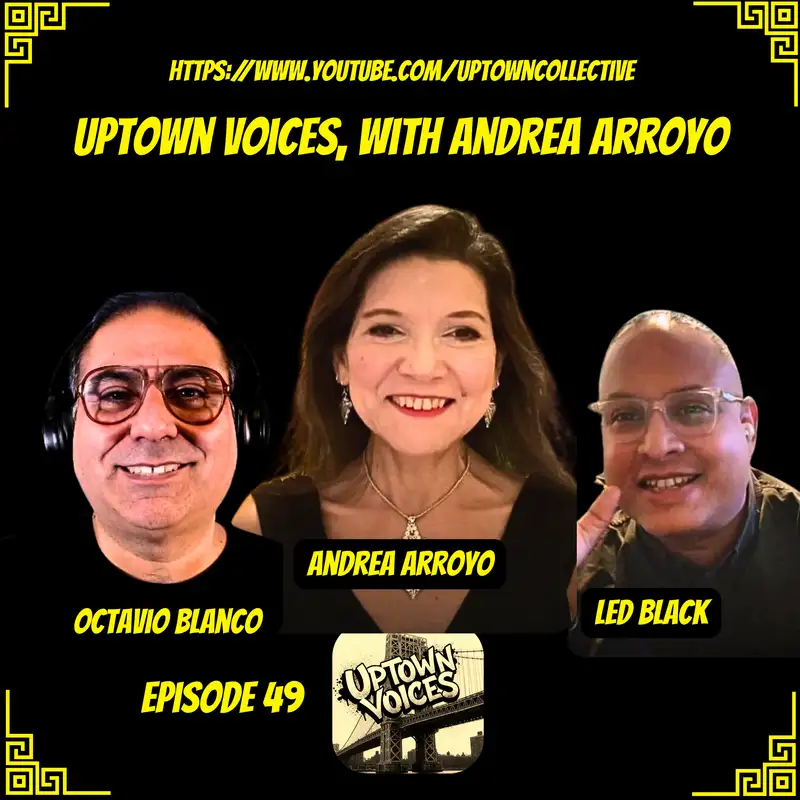
What up, what up, what up everyone, it's Led Black and my brother Octavio Blanco with another episode of Uptown Voices. Before I go any further, make sure you subscribe to the podcast, the Uptown Collector channel. Spread that love, show us that love. And today is a very special episode when Octavio and I were talking about Uptown Voices. One of the first people that I wanted to talk to was my next guest. She is, I think, probably one of most prolific artists of town. You know, when something's happening in the world,
Our next guest is going to come with an image that perfectly encapsulated. She's an art powerhouse, my friend, again, Uptown Art Luminary, Andrea Royale. Andrea, how you doing, sister? How's it going?
Andrea Arroyo (01:17)
I'm doing well. Thank you for having me. Excited to be here.
Led Black (01:21)
And I know you like to be traveling around the world, so I'm glad we got you. You know, we have a big, we're get right into it because we have a big opening. The 17th annual Women in the Heights Shade is coming up. I think the opening is February 25th, right? So tell us what we can expect. Tell us about Women in the Heights and you know, where it went from and where it's now.
Andrea Arroyo (01:44)
So yeah, Women in the Heights, I love it. I moved to the Heights around 17 years ago. So when I moved, I immediately contacted NOMAA and I brought this idea because I knew uptown had a lot of talented artists. I just knew a lot of women artists and a lot of talent. So I brought the project to NOMAA and they immediately embraced it. So it's been 17 years, so it's unbelievable.
Every year we have a different subject, a different theme, and the show has been growing just beautifully. It started with maybe 20 artists and maybe 40 applications, and it's been growing not only in quantity but in quality of submissions and also ⁓ in the reach. mean, we have a diverse group of artists. Every year is different.
We have a multi-generational, multi-racial, multi-everything show. And it's wonderful to see so many beautiful women creating beautiful art and sharing it with the uptown community and the community at large. So yay for women artists.
Led Black (02:52)
And the topic shade, right? That could mean so much. What are the, cause I think colorism, think shade, like throwing shade on someone. Like what is shade about?
Andrea Arroyo (03:04)
So exactly, so there are so many layers of the theme. So I thought immediately about throwing shade, but also sheltering in shade, Sheltering in shade, hiding in shade. So it is refuge, is concealment, it is protection, it is defiance. So it sometimes hides, sometimes reveals. And I think it's just perfect for these days, these times that we're living in right now.
There are so many layers and we have over 40 artists tackling the theme shade in very different ways, different approaches, different languages, different voices. Some of them are literal, people doing photographs about and our surrounding shade, but also more nuanced images and ideas, throwing shade, colorism.
And also just literal a shade of color, just color range in art. So I think it's gonna be very exciting. It's gonna be very exciting. And as usual, you the show is the landmark for NOMAA. The openings are usually fantastic. Everybody's just, you know, happy to be there and celebrating women's talent. So yeah, looking forward to it.
Led Black (04:19)
You know, one of the things I, and I'm sorry, Octavio, I'm just like such a fan of Andrew that I'm, I'm, I'm taking this over, but you know, one thing I love about NOMAA in general, but women in the heist particularly is that you have this beautiful cross section of like, you know, like, you know,
artists such as yourself or Rose Deller that are like experienced veteran artists and you have the younger folks that are coming along and it's like this kind of relationship where you they get to see you know from what an artist working artist looks like and I think that's a beautiful thing of that. Do you actively cultivate that?
Andrea Arroyo (04:53)
Absolutely, I think it's super important for artists of all ages to build that community, to feed off each other. I I learn more from my artists that they learn from me. So I think that's beautiful. And this year we have someone who's in her teens and someone who's in her eighties. And we have a range of artists. They're coming from all over uptown, Harlem, West Harlem, East Harlem, uptown, Inwood, Washington Heights. So it's a beautiful group. And it's also this time we have
I think around 40 % of artists were new to NOMAA. So that's even more beautiful because the community keeps growing. So I always say, know, once a "Women in the Heights" artist, you're always be part of that community. So it's beautiful.
Led Black (05:37)
I love that. love that. One last question. Have you been gone? Have you begun mounting it yet or not yet?
Andrea Arroyo (05:42)
Not yet. I'm excited.
It's going to start next week. So I'm super excited. And it's always a surprise.
Led Black (05:47)
Do you know what you're doing?
Do you know what you're doing or you're gonna know when you get there?
Andrea Arroyo (05:52)
I have a vision, but always, you know, the work, I mean, I have my vision of the design, but once you're there, the art work actually speaks to you and, you know, it kind of tells you where it wants to go. So, yeah, it's always very exciting. It's a lot of work. It's an amazing team effort with NOMAA and the whole NOMAA team. Everybody participates. So it's labor intense and a labor of love as well.
Led Black (06:08)
That's amazing.
Andrea Arroyo (06:21)
So super excited.
Octavio Blanco (06:22)
Yeah, hi Andrea. The question that I have is on the, a little bit on the economics of it all, ⁓ I guess, in a way. Because I think that it's, I personally am so proud of you for 17 years of setting this up, making sure that
women artists in the heights are getting, you know, the views of their artwork that they deserve. And my question though is also, does this event, because you yourself have such a huge network of people that you work with, you work with magazines, you work with galleries, you work with museums, both in the United States and internationally, you have this really
a global network of people. Do you find that by doing this, that it attracts not just people like myself and Led, who are huge supporters of uptown arts and other neighbors, but does it also attract people from outside of the community to come and see what the pulse is on the streets of Washington Heights for the artists in which is Washington Heights? And does it give these artists the opportunity to be seen beyond?
our neighborhood, which in my view is enough to be seen in our neighborhood. But I feel like there's that added level of opportunity for somebody who's either just starting or somebody who hasn't gotten the exposure that they deserve to be seen by the quote unquote like art industry galleries and museums and things like that.
Andrea Arroyo (07:56)
Absolutely, I the show is well known. We usually have a lot of media attention, so that helps. And also the artists themselves, they bring their communities, they bring their guests. And I have to tell you, it's not only about exposure, it's about creating this community that we feed on each other. So we not only give opportunities, but we create opportunities. And I also think...
I can share with artists how to create their own opportunities because sometimes there's this sense of waiting for somebody to see us or discover something. I hate that word discover and I hate the word exposure in terms of the art world because I always say people die of exposure and literally they do. I think it's super important for people to feel empowered and to have
Octavio Blanco (08:40)
Hmm
Led Black (08:40)
Hahaha
Right.
Andrea Arroyo (08:49)
that sense of agency to create their own opportunities and not wait. So when you have that mindset, you know, it's just better. It's just your work is going to be more visible. You're going to be more confident and it's just going to work better. Also, new artists have the opportunity to sell their work in this exhibition and we always have sales. So that helps them also encourage them.
It also cultivates a community of collectors. And they can be from uptown, they can be somebody who's never bought a work of art, but came into the gallery and just fell in love with a piece. Or it can be a professional collector who has a huge collection and that is an important collection. So I think it is a fantastic opportunity for everyone. And it's a fantastic opportunity for New York to see what uptown has to offer.
And I believe, I mean, I have not, I don't know how to work the numbers, but I do believe that Oak Town has the highest per capita artists in New York City.
Led Black (09:55)
Wow.
Octavio Blanco (09:55)
Yeah, it makes sense because it's one of the last, you know, more or less affordable neighborhoods that is around. I think what you said was so important though, that it's not about necessarily exposure because exposure has so many, it's a double edged sword in so many ways. The fact that it's community building, the fact that it's something that Led and I discuss on this show, ⁓
all the time, the importance of community building. And I thank you for highlighting that because I imagine, and I'm not an artist, but I do imagine that being an artist can be lonely sometimes. And it can be hard to break out of your studio and go out and meet other artists. So creating this opportunity has to be so empowering to other artists. I really appreciate that.
Andrea Arroyo (10:45)
Thank you. And one thing to mention is also that, you know, within NOMAA, you know, NOMAA has done such an incredible job in terms of cultivating this community, creating these safe spaces, and just having that embrace, just creates this environment of safety and trust that is really not common. It's something very rare, especially in New York City, because there's a lot of competition, there's a lot of...
Just, know, life is tough for many artists. So it's hard to get in a room with, you know, 200 people or 40 artists and feel safe and feel trust and feel embraced. And that's what I love the most about NOMAA. They have been doing that for many, years and it gets better and better. And I can also see it when I see the progression of an artist who started showing 17 years ago.
as an emerging artist and then the progress that they made and how they grow as creatives, how they grow as professionals. So that's also really beautiful to see and also really beautiful for the younger artists to witness.
Led Black (11:58)
And you have a question about like your output, like you're prolific in the sense that you're doing these shows, you know, like, like I said, you're global, you're actually traveling around the world. But whenever something, you know, you get precise in the sense like something happens today, you're to have an artwork about it, right? Like, I imagine, of course, that's your way of dealing with it. But how do you do that and still keep your head above water and still manage to do all the things you do?
Andrea Arroyo (12:24)
So I think for me, creating art helps me process it. It's kind of my way of dealing with it because sometimes, many times, especially these days, things are so horrible, so overwhelming, and you're already dealing with your own life, with your own stuff, and challenges, and every day. But then something happens, something large happens, big, horrible.
sometimes it's so horrible, it can be paralyzing. So what I do is I fight really hard not to get into that space. for me, that fighting is creating art. So let's say there was a, today there was a ⁓ mass shooting in Canada. So I'm already thinking of what I'm gonna publish tomorrow, right? And it's a lot of work. I don't have to do it, right?
In theory, I shouldn't have to do it, it shouldn't be my job. But it is part of how I deal with things, is part of how I think I can contribute something rather than just getting paralyzed or complaining or just talking about it. I do believe that art can change the world, I just do. And I also believe that activism is...
healing. know, it's not, you know, it's done as a service. When you do something as a service, it heals you and it heals the other. So that's, you know, the beauty, beautiful part of it. And I also think, you know, sometimes when all of these horrible things happen, people tend to just, you know, complain about it or just, you know, blurt out things. And I always say complaining is not activism.
Right? So there's something horrible happening. So my question every morning is what am I going to do about it today?
Led Black (14:12)
me just follow up on that. Yeah, what I find interesting is, because you're such an activist, because, you know, artist solidarity, which is one of the phrases you use often. I always thought that it would be you, not your husband, Feggo who who would be like, you know, become like a...
Octavio Blanco (14:13)
Go, no, go for it, yeah, please.
Led Black (14:32)
something for the authorities, right? I was so blown away when I heard Feggo's piece was taken down, you know, in the Latino section of the Smithsonian. I always thought it was you, you know? I was like, was gonna be you. How did you feel when that happened? Like, did that blindside you? What was the take on it?
Andrea Arroyo (14:50)
Well, you know, it was me first actually. Yeah, so in 2017, just the day after the election of Trump, the first term, I created a project title, Unnatural Election. And I invited over 400 artists from around the world to participate.
Led Black (14:53)
really?
I remember that, yep, I remember that.
Andrea Arroyo (15:13)
So I organized an online exhibition and exhibitions in galleries and museums, and I had a ton of press. And it was really healing for a lot of the artists because they needed that space to express themselves. And yeah, I had quite a bit of backlash, including a formal statement from Trump's advisor on diversity.
Led Black (15:37)
Wow.
Andrea Arroyo (15:38)
⁓
saying that I was anti-democratic and anti-American, all of those things. It was scary at the time, but this time with Feggo felt different. It felt much worse because in my case, I almost felt as if it was an opinion about me as an artist, as an individual. I that happens and it's pretty horrible but new.
who cares in a way, you I already had the exhibition up, know, freedom of expression is, you know, part of, you know, rights in this country. So, but this time with Feggo felt really, really different because it felt more of a strategy of an institutional position of a way of intimidating artists at large rather than just criticizing one particular artist, which was in my case.
It really feels now that they're doing this as a strategy, as a way of silencing artists and activists. And it just feels, I mean, it is worse. It's just different, it's more institutional and it's widespread. And it also is now backed by a lot of the supporters of these policies and this backwards philosophy, really. So...
It was shocking.
not quite surprising, was shocking, but it also, you know, it tells you about the power of art and how an image like Feggo's image was, is a sweet image. There's so much beauty in it. It's not a confrontational image, right? It's beautiful, it's sweet, it's humorous. And that tells you these people do not understand the language of love.
Led Black (17:11)
Yeah, it was very aspirational. Yeah, yeah, exactly.
Andrea Arroyo (17:21)
You know what I mean? It will be because they don't censor a lot of images that are more cartoony and more confrontational. They kind of know how to deal with that. when they see beauty, they freak out. And that tells us a lot.
Led Black (17:23)
Yeah.
Octavio Blanco (17:23)
Yeah.
Led Black (17:36)
Mmm.
That does, that really
Octavio Blanco (17:40)
I have a question for you, Andrea, about your roots, your Mexican roots and how they impacted your strident art. I guess there's like two schools of thought around art. One, guess, if, I'm...
simplifying this, so forgive me. But one school of art is just create art for the beauty, for creating art, and just do that. And then there's another school of art that is more strident and has a message that wants to impact society and make a social change. And I wonder, and I feel like that's part of what has sort of, especially with Mexican modernism,
Andrea Arroyo (18:06)
Thank
Octavio Blanco (18:28)
I wonder if how your roots as a Mexican artist have impacted your viewpoint as an artist today.
Andrea Arroyo (18:38)
Well, know, Mexico is in my DNA, right? So it really impacts every aspect of my life. do, I mean, I grew up in Mexico City. I come from a very working class background, but I was exposed to art in public spaces all the time, right? Because Mexico has this tradition of public art, murals, and just in general, it's a country and a culture that
perceives and absorbs and exudes beauty, know, everything. It's just like, know, a flower pot is not a flower pot. has, you know, a beautiful painting of, you know, something. And, you know, a fork is not a fork, but it has, you know, a little flower at the end. Like everything has this layer of, you know, aesthetic discharge with this aesthetic ⁓ influence and history.
So, it definitely influenced me. Now, I also am very passionate about public art. And I know for a fact that public art changes lives because it changed mine. So, you're a kid, you're four or five years old and you go into this building and it's a public building. your mom took you to get like a birth certificate or something.
And then suddenly you're facing these magnificent murals that honor and celebrate Mexican culture, pre-Columbra, pre-Hispanic. And it's just, it made me feel and strive for a world that was bigger than mine. And that stays with me every time. So yeah, it is an influence. It also,
Coming from Mexico, a place where I didn't feel as safe as I feel here, although these days I don't feel safe at all, but coming when I first arrived, it made me feel safe enough to speak about some things that I may not have done in Mexico at all times. it's, Mexicans, we're fierce.
and we're also you know it's such a beautiful culture and everything is layered and layered so yeah.
Octavio Blanco (20:58)
Yeah, no, that's true. And it's interesting that you came here and it sort of gave you the feeling of safety so that you could express yourself in a way that maybe you wouldn't in Mexico. And it's interesting what you were saying about public art and murals, because at this time, right now, in a lot of our public post offices,
They're destroying the beautiful historic murals that are there that depict our past. you know, this artwork is there to remind us not just of the great things, but also of the painful things. And that's one thing that I know in Mexico, what's so impressive is that many of the government buildings, say what you will about the government, whether it's good or bad or corrupt or not corrupt, but the government buildings are...
they value and they display artwork that doesn't always show Mexico in the best light, you know, it shows the historical mistakes that may have been made. And I think that that's part of what...
you know, shows what a society is to show the mistakes that you've made and strive to make amends. And look at Mexico right now. It's got a woman president. It's an incredible, an incredible change. And look where we are in the United States now. We have this horrible administration that's actively destroying historic artworks in public spaces, which is, is disgusting. So that's my, my, my rant.
Led Black (22:35)
Andrea, so why did you live, why are you gonna live anywhere else? Why you chose uptown? Why did you choose here and stay here?
Andrea Arroyo (22:42)
Well, you know, I wanted to be surrounded by artists as much as possible. I also wanted, just in practical terms, a large apartment with a lot of light, where my husband and I could both have separate studios and a separate office and, you know, just space. I wanted to have a pre-war apartment, if possible, and also access to nature.
I was a runner at the time, I'm a walker now. But access to the park and to the water was very important to me. So that helped. And just, you know, when we were looking for a place, we were going around all over Manhattan. And I first was looking at Harlem, and I love Harlem, but Harlem didn't have as many large spaces as we wanted.
Octavio Blanco (23:11)
You
Andrea Arroyo (23:31)
And also at that time it was a little bit of a food desert, which to me was very, very telling in terms of community. But Washington Heights had everything. I remember we came for a tour of historical Washington Heights.
And we went on this tour to Mauricio Mel, to Hispanic Society, to Intercession, to a lot of these institutions. And I figured, gosh, this place is filled with history. And at the same time, it's so contemporary, so vibrant, and so New York, in terms of diversity. we have friends who are from all over Latin America, friends from Russia and Eastern Europe. And it's just fantastic.
And it's also very accessible. So I knew that I needed to stay in Manhattan just because I needed for, you know, I have studio visits and people who come see my work. needed to be in Manhattan and have easy access. So we fell in love with it. Totally fell in love with it. Yeah.
Led Black (24:20)
Right.
Good luck to you guys, brother.
Octavio Blanco (24:37)
No, just, you know, I know that you travel quite a bit, quite extensively, and that you were recently in France. And I wanted to hear a little bit about your trip to France and how you were received there. And what is the mood in France, both in terms of you as an American artist coming over.
to France and also you as like a conduit to to speak to the French about what's happening in this country and to hear what their reaction is to what's happening in this country. Because in France, you know, it's it's also has its own right wing and it has its own issues which are, you know, are on the were on the rise. And I don't know where they are now. But I'm curious to hear about your visit to France. Why were you there?
And what sort of transpired while you were there? did it go over there?
Andrea Arroyo (25:34)
It went, I mean, for me, particularly, it went great. It was a beautiful trip. But I do have to say, we've been traveling for 40 years all over the world. And really, it's shocking how the perception of the United States has changed, right? It used to be that you arrived anywhere in the world, Latin America, Thailand, Europe, anywhere.
and you say I'm from New York, it was like, you know, you're cool, like immediately you're cool. And people have these aspirational ideas about what it is to live in the United States of America. And this admiration, right? That has changed radically, right? So, and the French are very expressive about their opinions. And so it's changing and it's tough because
Led Black (26:19)
Hmm
Andrea Arroyo (26:24)
The French in general are just very free to express whatever they want. And that's a very good thing. They communicate their opinions. And that's going to free country, though. That's great. I think the perception is that not only we're going backwards, but there used to be that perception that the US was just not
in general, a very worldly place. It was isolated in terms of their own perception of what the world was. And it was this kind of very focused on itself rather than on a global scale. it's understandable because it's a huge country. Europe is usually this, a bunch of different countries that kind of have to talk to each other all the time and they have for forever.
Octavio Blanco (27:10)
Mm-hmm.
Andrea Arroyo (27:12)
So the US is a little isolated in that sense. So that's understandable. But right now with globalization the way it is, it is not an option to be thinking in those terms isolationist. Now I went to France for an exhibition. I was invited to have an exhibition at Saint-Jose le Martel, which is just outside Limoges.
and I had a show of my project Imaginations, Art at Solidarity. So they showed around 80 of my works and I gave different talks and lectures. And we had thousands of visitors and it was a beautiful opportunity to engage with a different audience, especially with young people. They brought a lot of school groups, high school groups, and that was very, very interesting.
Led Black (27:45)
Wow.
Andrea Arroyo (28:01)
I also had the honor of receiving two awards. One was the People's Choice Award for the exhibition. So that's the exhibition that people like the most, which is very, very sweet. And the other was the award for freedom of expression. So, you know, very important subject right now in France and in the U.S. as well, and increasingly all over the world.
Octavio Blanco (28:14)
Yeah.
Andrea Arroyo (28:30)
So for me it was a fantastic opportunity, a great experience. We have many friends there and people are lovely. But I see the change of perception about the United States of America and it's and we need to do something about it.
Octavio Blanco (28:47)
Yeah, we definitely do but it's it does feel like the mask has been taken off because you know, I think for a long time the United States You know was able to hide some of its uglier sides and Right now the mask has totally been taken off and all of our ugliness is is exposed But maybe that's a good thing and in terms of art, you know, they say that you know, the the difficult times is when
the best art is created. And I see you responding with your art and your challenge to the regime with your art. You've mentioned it a little bit, but I'd like to ask you if you could go a little bit, if I could ask you again, just how do you protect yourself? And I don't mean physically protect yourself. I mean sort of like emotionally protect yourself when you're...
reacting to so much ugliness in the world, does your creation of art, is that cathartic for you? ⁓ Or do you have to compartmentalize and then go cry in a closet? you know, how does it, how do you maintain the beauty of your art as well? Because there is so much ugliness out there. So I find it must be challenging as an artist to still present the art.
Led Black (29:54)
You
Octavio Blanco (30:10)
beautifully, you know, which you are successful at.
Andrea Arroyo (30:14)
So I think that's one of my, you know, one of my goals all the time when I do this and I do an artwork about something that is really awful is to present it in a way that brings beauty, right? For me, I don't cry in a closet when I cry, I cry out in the open. I'm not ashamed, so it's fine. But I tend to...
You know, I cry for a little bit, but I tend to ask myself quite soon after, what am I going to do about it? Right? So because that feels empowering and feels like, know, I have agency. For me, I focus, it's very easy for me to focus on love and focus on tenderness. Right? So that's what I do. There are many artists who do more confrontational work.
that is needed and we need to hear those voices. But for me, I focus as much as possible on tenderness. Even when I'm doing an image that is strong or sad to look at, it has to have tenderness, at least in the line, in the aesthetic, in the visual. The visual has to be, give you something, has to give you some kind of hope, some kind of.
something. for me, I think it helps that my style is very fluid and very lyrical. I was trained as a dancer, so I think I bring that background to all of my art. Like everything moves in curves and is very fluid. And even when I'm talking about something harsh and horrible, let's say something like gun violence, the lines that are curvy and beautiful give me the sense of movement.
Octavio Blanco (31:42)
can see that.
Andrea Arroyo (31:59)
So that at the same time gives me the sense of, know, this is not a static thing. It can change. It will change. So it flows like everything flows, right? So that's what I do. I focus on love and I focus on tenderness and on service, basically. I make art to express myself, for sure. I like beauty. think beauty is absolutely needed.
It's a right and beauty is revolutionary. And it comes in many different forms.
Led Black (32:33)
You know, I love that about you. Just talking to you helps me understand your work even more. And I've already been a fan of yours. And it's also like, you don't shy away from things, right? You you've gone, you've talked, you already talked about Gaza, about Palestine, right? You have not shied away from the tough topic either. What makes you so fearless?
Andrea Arroyo (32:53)
I have no choice. We have no choice. There's not an option. We have to fight for what's right. We have to face the challenges. It's survival. It's basically survival. And again, getting into that space of complaining or feeling victimized, even though we are all at some point victims, is not productive.
And there is a way out. We have the power to change it. maybe we're not going change it tomorrow, but we can change it every day with little things, little gestures. That's why I always say focus on tenderness and love, because maybe we cannot change the outcome of the election, but we can change the way we treat our fellow, I don't know, subway riders. We can change the way we look at a stranger.
or we can change the way we approach something that we used to approach with harshness or ignore. And that changes the world, it ripples. So there have to be ways of love and tenderness. So I think that's my shelter.
Octavio Blanco (34:02)
Yeah, and I think sometimes love, tenderness, laughter, when we talk about Fuego, like in his art, you know, love, tenderness, laughter.
Those are ways that can kind of diffuse anger, hatred, and aggression to get actual communication to start happening. So, you know, I get that. I see where you're coming from. And I applaud you for sticking to that because I think at the end of the day, you know,
despite our differences, we have to find a way to communicate with each other and get our ideas into the minds of the people who may not.
completely agree with us. I mean, it's a challenge like led me and you, we talk about like Latinos for Trump a lot and how frustrated we are by Latinos for Trump. I found myself this weekend, in fact, speaking to a Latino for Trump and getting so, so angry that I just had to like walk away from the conversation because I didn't feel that the, that we were getting anywhere because there were so much, I had so much anger and he was sort of trolling me
looking for that anger. So I sometimes leave those situations and I feel disappointed in myself that I couldn't have a better conversation because I was feeling the heat but I had to turn around before it got into actual like shouting or something like that. But the work that you do, I find that it is more...
you know, it's tender, like you say, it's got fluidity and it presents something in a way that somebody will say, that's really beautiful. And they may not even see the message until later on. They're like, now I understand. And I think that's powerful, that's power.
Andrea Arroyo (35:58)
That actually happens quite often where people are attracted to an image and then they realize it has a different substance or content. And that helps a lot. And I always say, know, political discourse and we have been about this so long and we haven't been able to fix it, right? So talking is not necessarily the answer sometimes.
But art has this power of, it hits your soul, right? If the art is good, it speaks to you, right? And it allows us to connect to our humanity. So it does change people's perception. And that's why I always say it changes the world because even when you change one person.
like the perception we have about, I don't know, Latinos or women or this or that, if you manage to change that or shift it, that is the start for a change. And that's very, very important. And the other part is that joy itself, I mean, our existence is resistance, right? Our visibility is resistance, even if I'm, because sometimes I do paint just beautiful paintings.
I knew they don't necessarily show something politically out there, but everything is political, right? So even when I paint a work about flowers or mythology or women or the beauty of the female form, it is political, it's a political statement. And it's part of that idea of also joy as resistance and creating these spaces where we are seen in our full humanity.
Octavio Blanco (37:22)
Yeah.
Andrea Arroyo (37:41)
and as you know individuals and layered communities where you know we are complex you know as complex as anyone else.
Octavio Blanco (37:51)
Yeah, and can I just follow up just quickly to say, because you inspired me in what you were saying to me, as opposed to what I was engaging in over the weekend, which was a debate,
Led Black (37:53)
Thank you.
Octavio Blanco (38:03)
it's not a debate. Art is sort of like a statement. And the person who's observing it can decide within themselves, right? Because there's no, nobody is telling them anything. They're just looking at something. It's a very personal thing. Your political opinion is a very personal thing. And when you're debating somebody with words, I feel like sometimes a lot of that debate is just saving face, right? Somebody is just trying
to explain to you why they're feeling this way or why they choose this. But with art, so powerful about it is that that person is then having maybe a debate within themselves about why do I actually feel this way. And that artwork empowers them to say, to have that internal monologue that has nothing to do with anybody else and to maybe come to the realization that...
they need to make amends or that they need to respect women more or that they need to conserve the environment or whatever the case may be. Yeah.
Andrea Arroyo (39:06)
I see art as an invitation.
Right? And people engage as little or as much as they want at their own time. So it gives you this invitation to engage, to ponder, to ignore. Like you have the choice. So in that sense, there is no pressure. And the other thing is that you don't have to necessarily have an opinion about the art. You can and you probably do.
But you don't have to, right? So you're not expected to do anything, to say anything. And that's, think, very liberating.
Led Black (39:41)
You know, it's interesting. think we live in a world that's like completely out of sorts and out of order. And one thing I noticed about your work is that the sacred feminine really is a big part of your work and it's always been. Why? Why is that? Why is that important?
Andrea Arroyo (39:56)
It's a part of it is your survival. A part of it is, know, women have such wisdom and they have had this wisdom for, you know, since the beginning of humanity. And we have to rely on that. I think we have I have to tap into that wisdom in order to deal with the world sometimes. The world.
that we live in right now has a lot of the issues that are created by just testosterone fights where either a country or a person or a corporation, they just want to be bigger and better than somebody else. And I think we need to rely on that feminine wisdom in terms of thinking long-term, thinking protection of the environment.
and thinking more globally because I think sometimes women have the skills to look at the big picture a little bit better.
Led Black (40:57)
Yeah, I agree.
Octavio Blanco (40:58)
Yeah,
I, you know, you're talking to two men here, right? But, but I completely agree. I feel that like, this world has reached a point where the division of power needs to be more equitable for there to be more women.
you know, as leaders, I'm ready for it. I'm ready for the testosterone driven world to take a break, you know, because I agree. Like, I think that women have a different way of looking at it, at the world for the most part. I mean, in generalities, I do think women tend to seek community more than men. Men, and I think this is part of the
I don't want to bring it back to the Latinos for Trump type thing, but I do feel like there's a lot of lone wolves out there that are men who are just like, I can do it myself. There's like this machista sort of like, I don't need anybody else to do what I need to do to get the things that I need. Whereas women are like more, I feel like they're more like seeking of camaraderie, seeking of community, looking for ways that the group can.
can benefit rather than just one person. So I commend you for that art.
Andrea Arroyo (42:13)
I
sometimes it's not about women, know, having more, you know, an idea of community or family or these kind of more feminine things or skills. I think in general, what the female in general in nature has is an ability to multitask, right? So that helps.
So you're not focused on just one particular thing, but you're focused on a larger picture. And the other thing is that it doesn't necessarily mean men and women, but just a female energy that we all have and that we all can tap into and just connect with. And I think that will be just helpful. But sometimes, mean, these kinds of...
situations where people are, you know, just put up one against another and it's just this sense of a danger and fear that works really well in terms of instilling that, you know, just drive to survive by myself, for myself, my little circle, my little family. And we have to fight against that because it really works and it's what the system right now.
is do it, do all of us. So yeah.
Octavio Blanco (43:30)
Yeah.
And I appreciate that you bring up the fact, sorry, Led, just to follow up, because I want to make sure that this is really highlighted is that you're not necessarily talking about women versus men. I appreciate that it's more like the feminine.
part that lives in all of us, right, which many of us need to relearn in order to, you know, be open to expressing that aspect. We've been taught by our culture, our, by so many things, sometimes by our parents to, you know,
be men and be strong. And we're not really necessarily taught about how to handle our emotions and how to express our emotions, which are often considered a more of a feminine type of thing. I appreciate that you bring this sort of out of this binary that I was kind of discussing, which was men and women. And we're talking about this more.
holistically as feminine and that I, Octavio, you led, we both have like parts of ourselves that are more, you know, that are feminine that we need to, you know, we should be as men, all of us should be learning how to access and that would help us.
Andrea Arroyo (44:50)
Yeah, maybe I mean, maybe we could say something more instead of feminine, maybe see it as a holistic, right? So it's not feminine or masculine is more of a holistic universal sense that will help us kind of figure it out.
Led Black (45:09)
Yeah, and I think also a lot of this has to do with relearning certain things. think that, know, for most of us, right, you know, we're kind of like the products of empire, right? We come from somewhere else and, you know, there was like a thought, a value system that was imposed, right? And then it's about going back and finding our true values, right? And I think...
You know, we come from matrilineal societies at the end of the day, right? You know, most of us do, right? But so to me, you know, if this, we're living through feels like a culmination, right? This is what happens when you discover America. 500 years later, this is what you get, right? Like I think this is where we're living through right now. And I'm happy that you provide so much joy because
Andrea Arroyo (45:45)
Mm.
Led Black (45:59)
I tend to be kind of a pessimist sometimes, especially about the time we're living in now. So as an artist, as a very sensitive soul that has like a finger on the pulse of humanity, and I really do feel that you do that, why am I wrong? Why is this not a dictatorship? Why is this not like, what's your thoughts on where we are right now as a country, as a planet?
Andrea Arroyo (46:23)
I mean, you're not wrong, but there's much more than that, in my opinion, right? I mean, I think that we are living what we have been voting for. We are living what we have been purchasing and consuming for generations. have been, you know, especially in this country, the values
Led Black (46:40)
Hmm.
Andrea Arroyo (46:53)
have been material, materialistic, right? So when something like this happens, we're lost because we should be sheltering in community, sheltering on each other, taking care of each other and doing all of that. But I think in general, we have lost a little bit of that and we're scrambling for it right now. But I have to say,
I'm an optimist by nature and by necessity. Optimism to me is survival. There is just no other way to look at life because otherwise why wake up in the morning? And as an artist, I do the same thing. Like, you're in front of a canvas and the canvas is blank and you're painting and you're thinking this is the most brilliant painting in the history of the world. And you kind of have to convince yourself that's the case because otherwise why finish it, right?
Octavio Blanco (47:41)
You
Led Black (47:46)
Bye.
Andrea Arroyo (47:47)
At the same time, you're smart. You know it's not going to be the most brilliant piece of art in the world. But you have to, you know, I have to get into these dynamics of creativity and optimism and ⁓ power where I can tap into imagination and creativity in a way that serves me. And I think I go through life doing the same thing. Like, you know, when people are complaining, when things are horrible.
Led Black (48:10)
I love that.
Andrea Arroyo (48:15)
I think, okay, yes, they are horrible, but we're here, right? We're not them. We're just different and we, know, love is a wave and a tsunami that can change the world. And I was listening the other day to somebody saying that we maybe should think of those guys, like the right and the trumps as the opposition rather of thinking of ourselves as the opposition, because life is like a river, right? A river flows and it flows one way.
whatever happens, keeps flowing. And then right now, I feel like these people are trying to stop that flow of progress, of beauty, of humanity that we have been fighting so hard for generations and generations. And they're trying to stop it. It's not that they're creating a new thing. I mean, they know the river is gonna flow. So they're trying their hardest to stop it, to block it. And it's just not gonna happen. We're the river. So.
Led Black (48:53)
Mm-hmm.
Mm-hmm.
I love that. love that. So, Andrea, so, Women in the Heights Shade is opening February 25th. I will be there, Octavia will be there, Uptown will be there. But I know you have so many other things happening. So can you give us an inkling of the many things you're doing around the world?
Octavio Blanco (49:12)
I love that. love that. Yeah. Go ahead. Go ahead. ahead.
Andrea Arroyo (49:32)
Yes, so I'm spending three months and I'm going to Barcelona mostly to paint in the spring and then I have an exhibition scheduled for France in the fall. yeah, always something new happening and new projects going on. So yeah, exciting, always.
Octavio Blanco (49:51)
Well,
when we're talking about optimism, we were just like,
what I wanted to say is, Led, you've been sort of, you have this particular way of looking at the world, which I appreciate a lot, because you're very realistic about things, you always, what is it that you say, the,
sort of the, to have the, to be able to look at things negatively, right, is important. But, yeah, that's it. The failure of negative imagination, I totally appreciate that. But on the flip side of that, I find what Andrea, what you're saying, it made me think about all those people who are currently,
Led Black (50:22)
Yeah, I always say the failure of negative imagination. You know what mean? That's what I told you.
Octavio Blanco (50:39)
sheltering in community who are currently, whether it be in Minneapolis or Chicago or Los Angeles or New York City, we are sheltering in community. We do have our communities and it is helping us to feel safer. It is helping us to feel more empowered, even though it has sometimes the most negative effects, which is life ending, right? When we see some like
people like Pretti who were assassinated or Good who was assassinated. But like you say, that's the river that continues to flow because behind those individuals, there's thousands if not millions of people that are continuing to stand up to fight for what's right. And even in my optimistic viewpoint, making a difference so that folks who
say were enticed to the right are starting to see the error of their ways. Maybe not enough, maybe not everybody, but there are some. So.
I do also think that you're right that the river flows and this has been generations and that it can't be stopped and I hope it won't be stopped. I also believe that this is like a cornered animal when that's when they're the most dangerous and but that's also when they're the most vulnerable. So of course they're going to be loudly barking. Of course they're going to be lashing out. But we if we can remain strong we can we can get over that.
they are the opposition and we are the right, in the right is what I mean. And so I see, Led, your point of view and you've been on point for a lot of the things that you've predicted about what's happening and what's going to happen. But ⁓ I do feel that beyond where we are right now, there is still the optimism of a better world. So thank you for inspiring me, Andrea. I really appreciate that.
Andrea Arroyo (52:41)
You're very welcome. Thank you for having me.
Led Black (52:44)
Yeah, and again, I just wanna say like, I agree with you 100%, but I also feel that I feel that what's coming after is what, you know what mean? I think that this thing that we're living through right now is ending and a new world's being born and we'll go into the labor pains.
You know what mean? think it's going to be tough. I think I agree with you. Ultimately, we will be better off. But Andrew, like, again, I really want to thank you again for joining us, for expounding and just like, you know, like getting it's always amazing to see your work. And again, it just resonates. And again, it's interesting because you take these deep, deep topics and you and you encapsulate them, you know, and I want to thank you for that.
So I want you to tell our audience how they could follow your work, your social media, your website, and any last words you may have, Andrea.
Andrea Arroyo (53:37)
So last words again, I believe that art can change the world and that beauty is revolutionary. My website is andrearoyo.com. I'm on Instagram, AndreaRoyoArt and BlueSky and Facebook. So yeah, follow me and let's just join the river together and just be the river.
Octavio Blanco (54:00)
Be the River. Thank you so much. Thank you so much and thank you for speaking with us. This window into your mind and your way of thinking is really, really, really empowering and I appreciate it very much. So thank you.
Led Black (54:00)
Be the river. I like that.
Andrea Arroyo (54:05)
You're very welcome.
Thank you. It was a pleasure.
Led Black (54:13)
Thank you, Andrea.