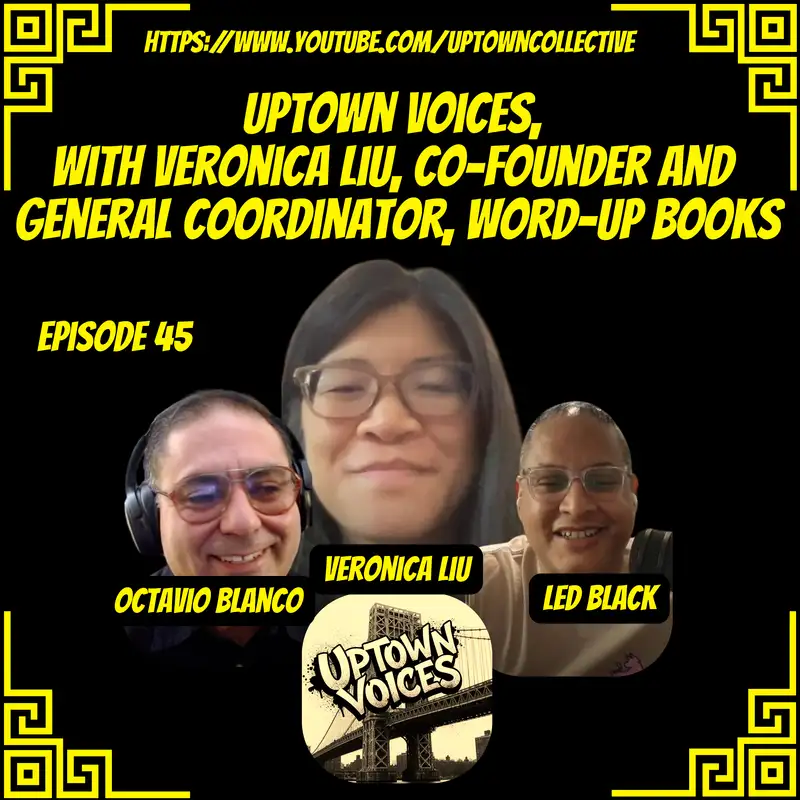
Word Up Books: Creating Community Through Literature. In conversation with Veronica Liu
Led Black (00:07)
What up, what up, what up everyone. It's Led Black and my brother, Octavio Blanco for another episode of Off Time Voices. And today we have a very special guest, my good friend and the co-founder and general coordinator of Word Up Books, Veronica Liu, who's a very important person uptown and what she's created reverberates. And I wish as a kid, I would have had Word Up. So Veronica, how you doing? How you doing sis? Good?
Veronica (00:35)
I'm good. How are you all doing tonight?
Led Black (00:37)
Doing good,
doing good.
Octavio Blanco (00:39)
Good over here, good.
Led Black (00:40)
Octavia, how you doing, brother?
Octavio Blanco (00:42)
I'm doing well. I'm really excited about this. I've been a fan of Veronica's for a long time. I remember Word Up when it was just, like I said, I like to say when it was just a cart on the street, you know, with a bunch of books. think that that's a, that was like the Genesis. And I'm so excited about this because honestly, like the organization that you have created is, like, Led says, it reverberates the neighborhood, but it's given us such an incredible
a resource for not just purchasing books, which is a great thing to do there, but you your events and stuff like that. I think it's a wonderful place that breathes life into the neighborhood and reflects this neighborhood.
in such a beautiful way. So I'm super excited. Led, don't forget, we need to tell our people to subscribe, right? Like subscription is what keeps us going. It's free. And we just want to get as many people in the community subscribed as we can. This is done, know, Led is Uptown Collective. So we're under the Uptown Collective banner. This show is Uptown Voices, but subscribe to Uptown Collective and you'll never miss an episode.
Led Black (01:34)
That's right, that's right.
Right.
Octavio Blanco (01:53)
of Uptown Voices.
Led Black (01:55)
That's right, spread that uptown love and show us some love on uptown voices. But Veronica, let's get right into it. So at this point, how long has Word Up been around?
Veronica (02:05)
Cord Up is almost 15 years old, which is nuts. It was just a little under 15 years ago when I think you and I first met. I remember kind of cold emailing you because I was like, uptown collective, got to this guy's input on stuff. Then we met at the Coral restaurant, Coral Diner, RIP, and talked about real basic things and then.
Led Black (02:07)
Wow.
Mm-hmm. Mm-hmm.
Mm-hmm.
Veronica (02:35)
went to go look at through the windows of a storefront that did not end up being the spot that we rented for the pop-up because that spot was rented the day that I was doing the actual site visit. But we had had the meeting strategically at Coral because it was like a few, you know, storefronts over. And that was, there's so many details I remember from that spring, from that summer, but that was 15 years ago.
Led Black (02:42)
Mm-hmm. Mm-hmm.
That's amazing. And what I find super interesting too is like, I remember being in your apartment, it was me, you, I forgot what, Mike Fiddleson, I think? Was it Mike Fiddleson or who was in there?
Veronica (03:12)
don't know if he was at that apartment meeting. Maybe Sandy Jimenez was there. I Robin. Robin Blass was there running around all the rooms looking for a fan.
Led Black (03:16)
Sandy Jimenez was there, yeah, yeah, and what was interesting.
Yeah, it was super hot. And then like, I remember, you know, we didn't have a name, right? And then either you call me or you send me an email saying we got the name Word Up. And it's like, I was like, why didn't I think of that? Like a bookstore in Washington Heights named Word Up, it's just like perfect. It's like the synergy is crazy. And I was like, yo, that's my goodness. That's such a good, good, like good encapsulation of what it is. So how did the name like, I remember like
Veronica (03:25)
You like that? Yeah.
you
Led Black (03:49)
really racking my brain and word up just fit perfectly. How did that come about?
Veronica (03:54)
Yeah, I remember, you know, it like lying back on the couch and talking to Will, Will Glass, ⁓ who also, you know, one of the founding collective members of Word Up, now my husband, and we knew each other before Word Up. But, and we were talking about, you know, just throwing out names and stuff. And I, there was something about like, Booked Up that I kept saying, and I was like, but it sounds like a nonprofit program if I say Booked Up, you know, or Read Up and then.
Led Black (04:00)
Mm-hmm. What I will.
Veronica (04:24)
So then I just started going down though, cause I really wanted the up was in there and you know, there are a lot of up, a lot of uptown things with up in there and uptown. I, so I wanted to kind of be along with that lineage of things named like that, but not quite with uptown. And then, you know, I think I burst out saying word up, like going through, you know, word possibilities and then sat up and we both looked at each other and I'm like, that was it. Sometimes when I would count that story,
Octavio Blanco (04:50)
great meme.
Veronica (04:52)
Will says that he said it, but I'm pretty sure I said it. Although I will give Will credit for naming recirculation.
Octavio Blanco (04:55)
Hahaha!
Led Black (04:55)
Yeah, yeah.
Gotcha, yeah, you know, I that all the time.
I try to claim credit from my wife all the time. So I understand Will's pain. But again, what was the drive though? Like why create this? Because like I said, growing up, you know, as a kid in Washington Heights, you know, I used to go to library. The library was like everything to me, but we never had something like Word Up. What made you say, I want to create this?
Octavio Blanco (05:03)
Ahahaha!
Veronica (05:06)
⁓
It's a lot of, you know.
I like some of it came of walking around the neighborhood. I acknowledge and I've felt so much so that I didn't grow up in the neighborhood, but I fell in love with the neighborhood the moment I moved into the neighborhood, which was about 10 years before Word Up started. And just walking around, looking at things, hearing things, enjoying, attending things, and kind of just having that sort of...
living with me in the background, but then also as someone who also like made a lot of, you know, did, you know, worked on things, writing or constructing zines or things like that. And often finding that the spaces that I was presenting them at, like where I was going to more reading specifically or attending zine fairs or kind of these multidisciplinary things that were like sort of literary related, I would end up, you know, signing up for them to
participate in some way and they were downtown. They were in Brooklyn, they were in Queens. they were, and I was, they were, I'd take the Greyhound out to Philly to participate in different kind of non-traditional exchanges of art. And often when I would go to all of these different places, I would find that I'd be tabling right next to somebody, like I'd be on the Lower East Side tabling right next to somebody who lived.
12 blocks away from where I lived. I would go to reading somewhere in Brooklyn, some place that was really annoying to get to on the subway and like somebody else on the bill would be from 12 blocks in the other direction. And so I think some of those things were starting to come together as things that I, and it wasn't like, I don't think there was a necessarily like a lack of that same kind of
Octavio Blanco (06:42)
and
Veronica (07:11)
culture presentation, people making stuff appear, but I think there was definitely like fewer spaces that I felt like, you know, where it was easy to kind of feel like you could go in and ask and propose something and see if you could make something happen. And so that was sort of one thread. Another thing was, you know, when I was at the time, I was working on a through this like kind of the now what is the nonprofit
It is like the legal structure that Word Up operates under. it was like about book. It's still is about book access. always was. And one of the first events we did, first programs we did was in conjunction with People's Theatre Project to do this writing and theatre after school program. And this was happening, you we're planning it throughout 2010 into early 2000 and it launched early 2011. And
One of the products of this besides these performances the kids would do is, which we'd make a book and we were like, we'll do this every year. We'll have this library of all this teen writing. But you know, where we were, you know, as we'd talk to the kids and where they lived, like there wasn't really a bookstore that was really central to where they were. and so that was like another kind of thing that was sort of running in the, in the background is like having a really more central to the neighborhood bookstore.
where then kids growing up in the neighborhood would have this place they could refer back to, they could go to that wasn't a time-based, you know, kind of arts event where you'd go enjoy it and then it'd be over and then you couldn't access that space again. You could go back and you could sort of have this reflective time and you would always be there. And I think that idea of like having a place that would always be there if possible, you know, that you could engage in all of this became, you know,
part of it. I've lost my train of thought. think a lot of it was, I'm walking around a lot. I'm walking around on 181st street. Like there's so many people here. There was a bookstore on this, you know, on this, like this blog or this blog. Like it would be a lot of foot traffic and you know, walking up and down Broadway. And I just like you hear music coming out of everywhere and you know, cause right from the beginning, the kind of events aspect, whatever was always a big part of Word Up. I know some bookstores don't have events. A lot of bookstores really do embrace events. And like this was always.
it was always a part of the DNA of Word Up that even if you weren't, even if it wasn't a reading, even if it was, there's just different ways that you can express story and express yourself and that I wanted to see all of that. I wanted to see what was happening. I could hear this awesome stuff happening in a basement. I wanted to see it somewhere on stage easily in the neighborhood. I, yeah, there's a lot of.
different threads. I don't know if I answered the question. I'm sorry.
Led Black (09:56)
You
definitely did. Yeah, and I'm sorry, Octavia, but again, I just feel you filled that void, right? And that was super important because you're right, it's not just a bookstore, right? It's like an oasis, right? That people can come and...
Octavio Blanco (09:57)
No, you definitely did. Yeah, you did.
Led Black (10:14)
be themselves, right? I remember as a kid, I couldn't be smart, like on my block, you know what mean? I had to hide my nerdy, my nerd, you know, like, you know, things that I like to do, you know? So in a way, this is a safe space. So, you know, thank you for creating it. I think it's super important, So thank you. And it's amazing to see what it's become. So thank you.
Veronica (10:32)
I thought of one other thing that like, you know, in terms of some of the stuff that some of the events that I would do in other places, if there was a bunch of people at them who didn't know each other, and then they would have, you know, while they're waiting to go on or do their thing, and they would meet each other and then they would, the next time we would put on that event, they'd be collaborating. Like we'd find out later that they'd actually been talking in between. And I love that too. Like it felt a little bit like, you know, having this sort of
living room where there's like the sort of collaboration brewing, if that could be in a bigger space, a shared living room with a bunch of neighbors, that would be awesome to experience. And so I kind of feel like that's happened to some extent. ⁓
Led Black (11:17)
It definitely
has.
Octavio Blanco (11:19)
Absolutely.
So, Veronica, you did give us lot of threads there and you did answer the question, but my question I want to sort of into like your love of books and your love of writing and how, when did that come about and beyond, now, you know,
running this incredible literary resource in the neighborhood, how has that like impacted your life? Like where has it taken you up till now? Like is it something that you've always had as a young woman where you were growing up and so tell me about this love of books if in fact that's part of what drives you.
Veronica (12:03)
Yeah, I think I don't recall a time that I didn't love books. I grew up with books. I grew up being able to go to a suburban mall in Toronto and sit in the corner and read till it's time to leave and to go to the library and school library. I know now it's so rare to have schools with libraries. But just at the time, I was able to access books.
I had my own books. I think there's always the memory or not of whether one's parents are reading. And I actually don't really remember my parents reading books for pleasure, but my dad would read the newspaper religiously. then I do remember my mom always reading textbooks, continuing education for herself and stuff. And besides that, this like...
gift that they let me have, know, just like reading tons and tons. I that's always been there. But then, you know, I think from the beginning to like from being able to put just pencil on paper, there's always been, I've always had some like, that's always been a form of expression that I've, like, taken to, know, whether it was
developing, like I look back on these really old notebooks and it's like these really detailed, elaborate pictures before I can really write. And then it's, then it's like really rudimentary stories about stuff. And, and I think that was a, and then it's, you know, really intense journals kept over the years. And then it turns into, you know, things that become a little more polished or, and I know that actually one of the, one of the real, like another thread that I forgot that sort of kickstarted.
like the conversation with Noma about Word Up was because I'd gotten one of the Noma grants to work on my novel. And so in the letter that was the award letter, it said, you know, if you do reading in the neighborhood, let us know. I was like, I don't know where I'm going to do reading in the neighborhood. That was one of the things that like both instilled panic, but also like, it shouldn't be that hard to think, try and think about where I could possibly do reading in the neighborhood, you know? And I think I was looking around, it wasn't like,
you know, I can look around and find things. I just felt like they were like very tightly curated or really in like, didn't really have any way I felt like I hadn't in to be able to do anything. And that, you know, eventually turned into, you know, months down the line or a year later, mentioning that in passing to Sandra from Noma and then proposing, you know, some other stuff from some of the other kinds of events I would do. And then that kind of rolled that conversation rolled into word up. But
The thing that, you know, like a later part of your question that is about what I think, or that maybe I'm reading a lot into it of the feelings I'm having now in 2026 of like life now is, you know, like I haven't finished that novel. it's, it's both in part because of just feeling kind of blindsided by the like amazingness of Word Up.
Led Black (15:07)
Hahaha!
Veronica (15:17)
But also feeling like it just took me by surprise, like just how consuming it would be when I'd only originally be planning for a pop-up, dreaming of something beyond a pop-up, but like not yet having done that kind of, not in advance, done it, you know, had done all the planning to make it a more permanent thing. And so, you know, word up. I love that it feels like it
rose organically. think part of it is just the part of me that is like a recovering perfectionist. You know, I think like I really had to like rub that away during that first summer of Word Up because you know, once a bunch of people have the keys to this shared space in the neighborhood that we are all asked to take care of because we've all decided
Octavio Blanco (16:07)
Yeah.
Veronica (16:11)
that we will take care of it. It's just things roll. And I think it was great in a way in getting rid of whatever anxieties of, and getting rid of that kind of affection that's really hampering to make something really flourish organically in that way. at the same time, it is like, there's like a, in the letting go and following where the energy is, it's hard to hold on to your own personal stuff.
Led Black (16:39)
Right, right.
Veronica (16:39)
And so,
you know, I love, I love, and I'm so proud of everything WordUp's done. And it's still like one of, I think the best things that's been ever in my life. And that I'm, you know, I also am really so like excited and happy that we're about to be 15. I also, every year look at that birthdate as like another year that I haven't finished X, Y, or Z.
Led Black (17:06)
Hahaha!
Octavio Blanco (17:07)
Yeah.
⁓
Veronica (17:07)
And that is like
lingering somewhere and that it's almost like I need some like totally different space to like then be striving to like I'm gonna go present there so that I can get my own stuff done. Like I don't, it seems ridiculous to say, but I feel like I don't even know if that's exact kind of exactly where your question was leading, but that's how I was reading it because I think that's how I've been feeling a lot in the last like maybe six months especially.
Octavio Blanco (17:20)
Yeah.
Yeah.
No, I
it's very honest. It's a very honest and response and I think you know, I laugh because it's funny, but it's also it's also very true and it's also You know, I can imagine on a personal level as you're on your personal like work as a as an author and a writer It's it's difficult. So, you know, I do hope that you know that that
It's interesting what you're saying about perfectionism and entrepreneurship, because really what you're doing is an entrepreneurial endeavor. And sometimes you have to let the perfect go for the good, you know? But I think that what you got going on is so much, is so above and beyond. And hopefully, you know, I do hope that as difficult as it may be, you know, that
in the years that are going, that have transpired, maybe you can think about how to focus a little bit more on your own sort of endeavors and maybe you can finish that book at some point. So I think that's a really, really honest assessment and I wish you the best on that for sure.
Veronica (18:44)
Yeah,
I think some of the intervening years too, I, you know, I've worked as an editor. And I think that's another thing that is like both good and bad when you're writing, you know, it makes, it makes you like, there are things that I'm like, this is, you know, you see the things that you
want to do and the things you don't want to do and then you're like, what am I doing with my time? You know, or you think I'm working with a genius, they've written the greatest things ever. Like, what am I supposed to do now? Like, I don't need to do anything. I can just read their stuff, you know, and it's like a hard kind of space to be in, because all of those things you can, you know, you can still be working with someone you think is a genius and want to read their work and you can still work on your own work and you can still like have a space where you can be
Octavio Blanco (19:14)
Hahaha
Veronica (19:31)
you know, your whole self and feel like, you know, being with other people who open up that space for everyone. It's just finding that balance and not having the external pressure for your own stuff. That's the hardest. Before you even throw kids in to the mix.
Led Black (19:49)
Right. And Veronica, let me ask you like, OK, one thing I think makes Word special is that it's volunteer run, you know, so and I know that was from the beginning what you wanted to do. How did you accomplish that? Right. Because, you know, I get what you're saying about not writing, know, because I don't do a lot of writing that I'm supposed to do either. Right. Because I'm focused on other things that I have to do because what you create, you know, has its own life of its own and it's a mess. But I think what makes you guys special is that it's volunteer run. How did that come about?
What's the idea behind it?
Veronica (20:19)
Yeah, we've, mean, from the beginning, think because it was this short-term thing, I it might be closed in a month. Everything felt so temporary. know, there was, there was a month of doing this while, you know, while I had a whole other job and while everybody was kind of jumping in for this afternoon, that afternoon, and then the space, you know, we had, lent for a short period. had, you know, insurance cover for that short period.
The furniture was from materials from the arts. was all free as long as you can get it there. And the books were on consignment. The artwork was on consignment. If it sold, then we would pay, but if it didn't, it would all be of given back at the end of that month. That month hasn't ended. now, I think that's probably one of the things that if we were looking at things way back, like if this turned into someone's life and
Led Black (21:01)
Ha ha ha ha ha ha ha ha ha
Octavio Blanco (21:03)
you
Veronica (21:12)
more than one person's life and how would we keep this sustainable? We might still choose to be volunteer run. We actually at this moment are not a hundred percent volunteer run, but we were for the first six years, a hundred percent volunteer run. So if I needed to, you know, write a particular letter about learn how to, you know, do like, I don't know, acknowledgement letters for like a year end campaign. remember.
Led Black (21:23)
Gotcha.
Veronica (21:38)
thinking, well, it's a very particular case. Sure, I could ask someone else how they do it, but I won't know if all the ins and outs of their situation are the same as ours. So just read a tax book. I didn't really know how to, I was like, let me just figure this out. But it wasn't like some of these things were already done or anything for us. in terms of,
But that was like all in the period of being volunteers, you know? And so that continued until, but a lot of, were having a lot of conversations about sustainability because one of the biggest things, the biggest ask everybody had, people would ask us all kinds of things, the word up to do or be, but the biggest one was always just, just be here. Like, how can you be here? How can you stay here? How can you be here for the kids? Me as a kid.
kids I have, et cetera, because a lot of people were saying, I wanted this as a kid or just how can it be a space where people can still imagine what else it could be that we haven't even done yet? so knowing that that was there, looking at ways that could really be sustainable alongside the group that existed, but also just
You know, we were seeing a lot of grants where, you you needed to have paid staff and, you know, it wasn't like we would only then do that grant. We only switched to paid staff because we wanted that. But we, think we were just looking at the reality of people's lives. mean, people, you know, when Word Up started, they go, I didn't have two kids. I didn't have, you know, and I think that other people, and I think I didn't even realize then, like how...
just the kinds of that kind of instantaneous like, let's do this right now, because it's a pop up, we don't know how long we'll have it for. That's awesome. And it's inspiring. But like it is a little limiting to all corners of the neighborhood, all corners of the community, because not everybody can like drop everything and go do that and be able to, you know, be in person in all these ways and lift a lot of stuff and and just be meeting at like 8pm on
every other day. you know, there's like a lot of stuff that I think as Word Up has developed, and we've tried to see other ways to be sustainable for to really have the participation of a wider group of people, you know, I think we were realizing it's just things but, you know, I think the thing the real kick in the pants, all the talking about stuff is like after I had, and, you know, my first kid,
then it felt like I had like three full-time jobs. I was like working my job and then working word up for free. And then there was like this whole other being that I was like needing to care for. And then, whereas like two full-time jobs, even if one is unpaid was definitely a lot. mean, three was just felt impossible. So that was one way, one thing that kind of really, really like
Led Black (24:29)
Right.
Octavio Blanco (24:39)
Yeah.
Led Black (24:40)
Bye.
Veronica (24:46)
pushed that transition to having paid staff. Even then we went through this period of like kind of discussing it like prior to when Lester was born, but then even a year after like how that transition would happen within a collective structure that had been 100 % volunteer. I think one thing that actually helped a little bit was that we were like looking at the number of hours people were doing and all these different corners of Word Up. like it was at that point pretty clear that I was still
Like I was doing a lot of hours that are like beyond kind of akin to a full-time job, but then other volunteers were very, very active and very regular. It was like much different hours asked though, you know? So I think the fact that we then on like we worked, you know, over the course of a few years to build up a salary and then have me come on as the first, you know, this paid executive director.
Led Black (25:21)
Right.
Veronica (25:40)
That's how that transition happened. then, you know, when we were kind of, we have this summit every year, the Word Up Collective, where we try and do it every year, where we talk about these big picture issues. The summit kind of right before, a couple of summits before that transition to having paid staff, we kind of drilled down what people really wanted out of, you know, do you really just want it? Some people really wanted to, were like saying they wanted to stay volunteer.
And, then when it came down to it, was like, what they really wanted was like this like non-hierarchical like structure. they would, they would kind of be okay with paid staff to kind of keep this like daily through line happening as long as there was still this like, you know, striving for like collective process, non-hierarchical decision-making. And so I think that's one thing that we've.
felt like is like embedded in Word Up. you know, it's been there since, you know, like since early on. And like, that's one thing that we feel important about continuing. We do have like three paid, like three full-time staff members now though too. That is alongside right now, like 80 active collective members.
Led Black (26:59)
Wow.
Veronica (26:59)
Um,
so that's people doing three and a half hour shifts at the store, either at word up the main location or at recirculation or doing, um, like an administrative role. Um, and like, or doing a lot of offsite events, like in a regular enough way that they have to keep up with what's going on. It's like, that's where we're kind of, we have a lot of these definitions of how we have active, you know, area inactive and everything in between. Um, but that's.
Yeah, I think it's almost 80. It's more than pre-enduring pandemic. The sort of active number of people who are so invested in things. I think some have been there for all 15 years.
Led Black (27:36)
That's amazing.
Yeah, shout out to my brother, Emanuel Abreu, who's been part of... Yeah.
Veronica (27:50)
you
Octavio Blanco (27:51)
Yeah, photographer extraordinaire. Look, I have so many questions. I have so many questions, so forgive me, OK? I'm going to ask you first just one. So.
And I guess this is a good opportunity for you to help people to know how to contribute to help you guys out. But how are you funded? Like where does the money come from? Is it mostly from individual contributions or is it mostly from grants or is there like a nice split or tell us? And for those people watching who are like interested in what you do and want to contribute monetarily, how can they do that?
Veronica (28:31)
Yeah. Thanks for asking. But especially the part about people who want to contribute monetarily, always feel free. recently launched a new website, wordupbooks.com. And on that there are ways you can think slash donate is a way to donate, but you can also just buy books on the site. Our funding sources have shifted. know, there's always a split in a way that actually
relieves me at times of, we've experienced a lot of emergencies over the past six years. And I think the fact that there was no one way that it was funded, that if that stream went away, we would fold. I think that's been good.
⁓ And I think that another thing that's been helpful is from the beginning, it has been a lot of individual contributions often for, you know, when we were at the Broadway pop-up, when we were at Broadway and 176th and, you know, all the books for a while were, all the used books were free because we were like, we'll be, you know, closing up shop in a month or when we got an extension, like, closing up shop in two months. We'll just instead of having
Octavio Blanco (29:43)
I'm
This is never going
to last.
Veronica (29:47)
with all these books, you
know, well, just give them out for free. then, know, pile would deplete and then it would rise right up again the next day. And it was like, but we, you know, for we were charging for, you know, all the like consignment, local author books and stuff. But in this, you know, small presses, but these books that were free people were like, again, that emphasis on like, we want you to stay even if you aren't you're here in this temporary way. One day you might
stay and one day you might have to pay rent. So take this $5, take this $10. So in theory, know, first they were kind of in name for these, for the books, that's the one, you know, book that they were grabbing, the beat up paperback from, you know, wherever. then eventually we started putting price tags on those books and they were still used books that people were donating. we, as we got closer to then actually signing a lease and paying rent, had a, you know, our first
rent party and made this like sort of donation program. So, and then started trying to like have like the baby version of a year end campaign, you know, that nonprofits we knew did. you know, early on it was sort of split between book sales and individual contributions. And we knew that we were, you know, as a nonprofit, we could be applying for grants, but
We just didn't have capacity to, like I, you I didn't have, you know, we would try to, but you know, we couldn't do it in a sustained way. And we didn't really add in that as like a proper funding stream until a few years in. And then, then, you know, it's like, great, these awesome baby grants, but they're like, you know, a couple thousand dollars to do one specific program and, super helpful in carrying that out, but like not able to pay rent with it or anything. And then now at this point.
it is a much bigger part of the mix because, you know, as we've now that we're 15 or getting on 15, we're eligible for stuff. You know, we've been eligible for the past few years for things like New York State Council on the Arts or Department of Cultural Affairs. And so and other foundations or anything that any way that people want to donate to us, we have, you know, I know that there's still a lot more we can do with that, but we just again, it's like a capacity thing. It's like how much
Octavio Blanco (32:05)
Yeah.
Veronica (32:06)
time do we all have to be chasing it? I'll have to make time, I guess, so we want to for all the other for the big plans we always have. But in the meantime, it's a it's a pretty it's a pretty even split between individual contributions, grants, which are much ⁓ greater share than before and then book sales.
Octavio Blanco (32:26)
Interesting and I thank you because because people don't realize just how limited some of these grants can be You know people think I'll get a grant but like you oftentimes grants are like, okay But you can only use this money for this thing and it may or may not like fit into your plans into your organization so
Veronica (32:46)
Yeah. And I think one harder thing we learned the hard way as we were growing enough to be eligible for bigger grants is sometimes they don't give you that grant till like they don't, it doesn't come through, like into your account until long after you've done the thing that you were doing with it. So it's like, it's, know, anything that's a reimbursable grant or anything that's, just
it's not necessarily supposed to be reimbursable, but it's just severely delayed because of whatever else is happening in the city. Those situations have closed some nonprofits that are much bigger than ours and we're relying on a much higher share of their budget on that. And I think for us, put a real strain on us when we were learning that that was sort of how things go a few years ago. ⁓ But yeah, I think...
Octavio Blanco (33:34)
Yeah, wow. Go ahead, Lyd. Sorry about that.
Led Black (33:36)
Hello
Veronica (33:37)
People also just ordering books for, you all the different ways people order books. I mean, there's like people who sometimes will put it as part of their registry for, you know, baby shower. People will order books for, you know, for either schools can officially order books through us, but also sometimes if there's someone building a classroom library and wants to like help their teacher out and their kids teacher out to do it, like there are a lot of ways that people do like these mini.
They're not really fundraisers, they're maybe also book related, but just doing bulk orders, that's also quite helpful. it's then still really on, there's a lot of ways in which trying to do stuff that's aligned with our mission too, of just book access in all our communities that don't necessarily have that easy access to books of a particular kind or representing kids that are like...
in the neighborhood and things like that, that will definitely help. a lot of people have gotten really used to buying things on Amazon. you know, there's, there's like a lot of stuff available on Amazon, but they specifically use books to like, as like the loss leaders but there's alternatives to Amazon, even if you're not getting
Octavio Blanco (34:46)
Absolutely.
Veronica (34:48)
directly through us, like you can also use bookshop.org. Bookshop.org was created as like a way to, as like a site that would also do just like kind of permanent discounting and, all of their extra funding, if you click through to bookshop.org from Word Up site, like we get a cut of that. Like, and then if you do, if you buy something on the page that is the Word Up page, like we'll get a cut of that. And then,
Another thing they do is like after all the indie bookstore, like all the purchases made through them, they then split all this profit to all these indie bookstores. And I think their aim was to be like a more, a little bit more seamless experience in some of these like clunkier, you know, individual e-commerce sites. But, you know, you don't necessarily have to go through us specifically, like you can go through these other sites.
Octavio Blanco (35:34)
But you should,
you should, because you can, because you know, you will, you can pick it up at the store or they can deliver it to your house. go to wordupbooks.com. Is that the website?
Led Black (35:36)
Be sure that's right.
Veronica (35:38)
Yeah.
Wordupbooks.com. We personally won't be there delivering, but you can put it in the mail. Or you can pick it up. I think if you come pick it up, then you have, then you get some vibes. Like you just, you can visit us.
Led Black (35:51)
Hahaha
Octavio Blanco (35:51)
Yeah, yeah.
Led Black (35:58)
Vibes.
Octavio Blanco (36:00)
Definitely.
Led Black (36:01)
And speaking of vibes, right, like I think that's another thing that makes Word Up so special, right? Like I've had so many nights of like pure magic at Word Up. And I remember one night it was, and I'm gonna give credit to my wife, right? So she found out Chris Hedges was gonna be at Word Up, you and I'm a huge Chris Hedges fan. I love his work. And...
Then, so we were set to go, but that night I got home from work, I was like, yo, I don't wanna go. I love Chris Hedges, but I'm not, I'm tired. And my wife was like, no, I'll pay for a cab, we out there. And she forced me to go. And it worked out because what ended up happening was, it was supposed to be Chris Hedges interviewing some other author. And for some reason, when we got there, the author left. I don't know if he didn't, so he left.
So it was just Chris Hedges. So then it's me because I'm such a Chris Hedges fan. It became like Led Black in conversation with Chris Hedges. And it was just such a fantastic, just amazing night. He sent me like all his books signed. You know what mean? Like it was such a, so I guess I forgot who coordinated it. She was like, Led, Chris was like, so, you know, really liked you so much. He sent me all his books, what's your address? So I got like tons of books from Chris Hedges signed. But I mean, it's that magic that.
that happens at Word Up. And, you know, like, I know you don't intentionally want to create magic, how do you think that, why is that a place of magic?
Veronica (37:24)
exit
gathering people, there's always surprises that happen when you gather people who are...
I know who were into it. don't know. This is not a very good answer so far. I'll come up with it as I go along. ⁓
Led Black (37:37)
No, no, I get it. I know what you mean. No, I know what you mean though. Like
Chris Hedges was again, Chris Hedges was so giving of his time. And then I was just there like, and again, it was just because I had so many questions and it turned out to be this like wonderful knowledge. So he ended up even, he was telling us about how he works in the prisons. So he teaches, you know, you know, convicted.
people how to, you know, just how to write. was like, I think a creative writing class. And he even cried during the day. It was just such a beautiful night uptown with one of my favorite authors and just one of the most, I think Chris Hedges is beyond like, I mean, he's super incredible, super important to read. So again, it's just, I thank you for creating, like you said, that gathering is magic in that, you know? And how long were you guys in 176 and Broadway? How long did that last?
Veronica (38:23)
15 and a half months. Yeah. And I think that that maybe, I don't know, had magic kind of embedded into it. Like you just, get some people together who want to see something happen, who want to make stuff happen with, you know, by themselves, but then with each other. And then
But don't like...
put too many, like I think part of the...
There's so many ways I want to answer this question and I'm not finding the right words to... Like leaving room for there to be like a blank page, leaving room for there to be a blank slate. Like leaving, like if anything, feel like leaving that space for someone to come in and hang their own stuff on the wall. Like I think there was a lot more of that in the early days. I think, but it still can happen to some extent today. ⁓ There are...
in some ways, like a little bit more, like there's a little bit more, you know, I don't know. I think one thing that whenever the idea of like curating something comes up, we, you know, both like have a desire to, but also desire to like not do it too much, because I think that magic has happened when you leave room for what you aren't expecting from the people.
who you don't even necessarily know in your neighborhood who will come in and like enter the story in a way that you don't expect at all and you couldn't have imagined and you couldn't have planned for. And being open to that magic, I think is another part of it. And I think what you're...
What I feel almost every day at Word Up still, like maybe not every single day, but like several times a week, is this like element of surprise and that I feel like I am ready for it. And I don't know if I had it that regularly in my life prior to Word Up, but it's because it's a place that, I mean, has like fostered it.
Led Black (40:08)
Bye.
Veronica (40:23)
It comes up, it's there, we're ready for it. We're like ready for whoever walks in the door and like want to go with it. And then I think when that surprise sort of manifests in a way that is like awesome, that's where it feels like magic. Sometimes it leads to like a need for deescalation. don't know, like, what I think we're all, like.
Led Black (40:42)
Hahaha
Octavio Blanco (40:42)
Hahaha
Veronica (40:45)
ready for whatever it is that comes through. And I think more often than not, you know, I feel, especially during this Word Up experience, that the world conspires more to like, you know, like it, you know, it sort of wants things to work out. But I think they work out because you kind of...
I don't know if you have such a prescriptive way of what it should be, like then it won't necessarily, things won't always feel like they work out. But if you're willing to like adjust your perspective on what it should be or could be, then, and you just arrange things a little differently, then this amazing other thing happens that like no one could have imagined that blossoms out of it, that every, you other people feel then invested in and carry on. And I think, yeah, a lot of it just comes from not trying to be too prescriptive.
Like being not being, I don't think it's being not organized. Like I think it's, I think they're actually, it's helpful that if there is like organization and like heart and thought behind it, but like, like doing that in service for what comes your way, you know, I think is then a way that like this neighborhood has made this bookstore. Like it's not, you know,
Led Black (41:54)
Bye.
Veronica (42:01)
I do feel like with all of the things I can look around at WordUp and see all the different ways people have left their imprint on it and will continue to or have designs on trying to fix that thing. It's not quite to what they want. I really do feel like it's been this co-created space and I hope that it always will be.
Octavio Blanco (42:14)
Hahaha.
Interesting. Interesting. if I could, I do, you mentioned a little bit about how you're, how you're organized, right? It's a collaborative, it's a co-op. So tell me a little bit of how you make decisions because it's not like you're not organized, right? You do have an organization, but ⁓ the decision-making process must be complex and vociferous. How, how, how
Led Black (42:34)
Hahaha
Octavio Blanco (42:45)
How do decisions get made? How do you steer the ship? It sounds very democratic and to a fault, right? So sometimes I wonder if that's the best way to organize, but it sounds like it's working for you guys.
Veronica (43:01)
Yeah, I think it's working so far, I think in part because the people that come to it and see that it's different from how they have to operate in the rest of their lives or how, you know, it's not the only reason that people come to it and are attracted to it, but I do know it's one element of what people do here, because you can, that place to explore.
what it can be, what it can be like to try and come to a decision with a giant group feeling knowledgeable enough to really make that decision and invested enough to care about the decision is a real, can feel like a real feat when it happens, in a way that people find satisfactory. But we've explicitly decided
And this is like checking with the group of like who we were kind of deterrent, like, you know.
Any collective kind of has these like, as it develops, I feel like these sort of mini generations kind of come up, you know, there's people that come into it five years in and things seem established because people have been there for a bit. But, you know, and they don't realize how much we like necessarily made that up as we went along. And then people that are coming 10 years in, like now it's even more established that whole five year set, you know, also then was folded into and was in part of the making of extra Y policy. And so
I think so much of the challenge is also trying to share enough of the history, the making of anything so that people know that it didn't come out of nowhere. It came out of something maybe happening and that we all talked about that we then wanted to make sure happened differently if it happened again or didn't happen again or whatever we could do to try to facilitate whatever happened. But then also leaving room for like...
review or people to change like that policy or procedure. That said, one of the things that kept coming up was like defining who was active as a collective member, who was inactive, because it's really clear who the active collective members are, really clear who the inactive collective members are. But that whole spectrum, like that space in between where someone is, was active, maybe is becoming inactive and like at what point do they stop getting
Octavio Blanco (45:07)
Mm.
Veronica (45:23)
decision-making power to the same extent as like the weekly shift holder, like the really active person. So we had to start defining what that was because, you know, like several years in, we were getting all these different levels of, you know, participation and needing to sort of just, you know, figure out, you know, someone who hadn't been active for seven years, could they still vote on this thing or not? We don't even really have voting that often, but.
One of the, so in the process of defining what makes for an active collective member, we then had a series of meetings because we could never get all the collective members in one meeting. So we just had a series of meetings that we said, okay, everybody has to come to one of them. If you count yourself as active, come to one of them. And then we went line by line by like, do you feel like this definition fits that? and we, think the first time we did this series was the most arduous because it was like defining things for the first time. We've tried to do that.
Octavio Blanco (46:00)
You
Veronica (46:17)
every couple years since, but it's, you we're not going as granular as we did that first time because there's been like history behind why, you know, things were. But in that first series of conversations, we checked with everyone that we talked to and maybe I think 30 something people were like able to make it to those first rounds of conversations until the pandemic stopped. You know, we then didn't do it. We kind of weren't able to do our last session of it, I think, because it was locked down and we just.
moved on to other things. But we asked, do you should we operate on consensus? And across the board, everyone was like, heck no. I don't want to have to weigh in on everything. we are okay with you know, people have named roles, or definitely people who have more investment in x, y, z, or like have more time to spend on x, and z, have more knowledge of this, like I'm happy to defer consensus, like, and if it affects x, you know,
Octavio Blanco (46:54)
Hahaha
Veronica (47:15)
ABC or D, like, maybe I'm more interested. But otherwise, I don't need to weigh in on everything. Please, like I have a life, you know, it's been that really opened up some doors because we could then move forward knowing that we, you know, like the decisions are weighted to who has the burden of execution. So like, if you are dealing with events, and you're very active in that and like you're
Led Black (47:23)
Hahaha
Veronica (47:41)
job is that or you're like, you or you're just one of the active event organizers as a volunteer, you're always present for them. Like you have more of a say in how things go with events. If we want to change up something, like you have more of a, you know, more leeway to like override or make the call, but otherwise, you know, we just try and share with everybody as much as possible what we're doing. And then the things that we do really want more collective wide buy-in is if anything is affecting the safer space policy or the code of conduct.
So for those any issues that are to those two documents we have that we have all volunteers sign when they're onboarded, then we like share what the issue is and whatever platform used to be a Google group and now a space camp, this like project management software. And so we share the info and we have a meeting and then we'll take minutes of the meeting and then we'll share the notes from the meeting and.
You know, like those kinds of changes, like we have a few steps before like a change is hard and fast change, but like only really for those, things that affect those two things will we do it for. And then otherwise we'll just try and share as much as possible of like, whoa, what's happening different, you know, different teams, different groups are like, we hope that they all kind of take the leadership on like sharing what that info is with the group. And, we also, think part of this document that was like defining what all the, you know,
collect how what made for an active collective member. also were defining what would like lead to like if you picked up a task or picked up a project or like initiated something, but then if you know what we're what we as a group will be expecting and like what if you then fall through hard like if you like drop the ball hard like then what the group would also be expect, you know, and like kind of what so there's there's some
You know, that always needs to be fleshed out a little bit. Like that document we need to, I need to kind of rewrite in some way. Yeah. We were trying to rewrite it a little bit based on, based on the summer sessions where we were like talking about like, you know, kind of tonally, it was like a little bit off, but otherwise like people have been like looking at it as a guide. okay, this is a, this is sort of his level X level of, you know, importance because it has a deadline, involves outside parties.
Octavio Blanco (49:39)
Accountability is tough.
Veronica (50:00)
Like I could pick it up because I have capacity to. And then there's some things that are like, you know, kind of not as, not as like, if it doesn't involve like outside world and doesn't have a deadline, like it's definitely at a different level. But I think we had to have something like that in place. Cause we were finding in the early days when we were like, Oh, we're a collective. And everybody was like, yeah, like just if someone would drop the ball on something, then like somebody was left holding the bag because of.
was as WordUp was growing in in, you know, name recognition and like what, you know, different institutions in the neighborhood were like starting to rely on it. Like if someone was supposed to open up for a field, a school field trip or things like that, like we couldn't really, you know, just like not be there. ⁓ And so there are different levels of like, you know, urgency and accountability and
Octavio Blanco (50:53)
That's interesting.
It's fascinating. It's fascinating.
Led Black (50:56)
Veronica, so you guys have been at 165th and Amsterdam like 13 years now, right? So, so, right? How did the recirculation come about? cause for real, I didn't even know and I was like, recirculation, what's that? Like, and it's this beautiful space that adds another whole, you know, component to where, how did that come about? Cause I love recirculation as well.
Veronica (51:03)
Yeah, middle team.
Yeah, recirculation came about when...
I think the shortest story is to one of our longtime collective members, long time from the early days, like the first four five years was very, very regular, like would come and work at Word Up several days a week was Tom Burgess and he passed away from COVID June, 2020. And he went into the hospital the day, the day after
the day before his 70th birthday. And sometime while he was in the hospital, you know, he called and he mentioned that he told the nurse to like crank up his oxygen so he could make the call. And I knew he was in the hospital because Emanuel actually had talked to him like a week before. Emanuel had been the last, I think, of us to see him in person because he had been delivering medication to him.
So wouldn't have to go out. but Tom cranked up oxygen and then said, you know, in case I'm incapacitated when I come out. So, you know, not in case I don't come out, but in case I can't do all the things I wanted, you know, able to do when I come out, take down all these numbers. Just like, send me this like list of, you contact my sisters.
⁓ contact this, that, and the other. you know, he told me which shifts at the Manhattan mini storages and inwood like were friendliest and had all kinds of, you know, side info about everyone like usual. ⁓ and yeah, I think he wasn't saying anything about, you know, just like,
the passing and not coming out at all. But he did mention in the call, like he had said for years before that I was like the sister that he never had, which was always a funny phrase because he has two sisters who he loves very much. But, you know, one of which I called right after I hung up the phone with Tom. yeah, it was so, you know, needing to just
Led Black (53:18)
So wow.
Hahaha!
Veronica (53:34)
collect all the details of, you know, of Tom's, like, just like the administration of whatever, you know, in these last in like a really quick, you know, not even probably 10 minute conversation was like, was a lot. And then right after I talked to one of his sisters, and she had called, she had just called Tom.
right before I got through to her. And she said she had just called him, but he couldn't speak anymore. Like he had just had like passed on all his info and then was like, the auction sort of like took down a notch and couldn't, yeah, like couldn't communicate. And that was...
So I got updates from his sister. And then eventually when he passed, I just like, of was working with his sisters to sort of set all his affairs.
He four storage units in Inwood. Three of them were floor to ceiling crammed with books and records. And then, you know, I knew of this space that had been empty for almost 20 years, which is now recirculation. And so had proposed to the board of this building if, you know, we could move, you know, Tom's stuff here and sort it and then
you know, kind of have a space for that. you know, kind of unexpectedly, one of the people on the board of this building actually knew Tom and had gone to grad school with him decades before and was like, of course, this is what a, you know, and connection. So we ended up, you know, trying to move stuff here, move, a lot of stuff here. And then in the process of sorting it, you know, it was a moment when
Led Black (55:05)
Wow.
Veronica (55:19)
The COVID numbers were going up again, it late 2020, early 2021. I don't remember if it was Omicron. I don't remember what all the names were, but whatever was at the time that was like making things close again. I think we even closed Word Up.
Led Black (55:28)
Yeah.
Veronica (55:33)
I don't think we were actually open, but other businesses were closing again. And so at the turn of that year, while we were sorting things in the space and like opening the door, people were walking around and like not really able to go to some shops or the places that they used to go into indoors, but it's cold and everyone was on walks those days. And we would walk by and we're curious about what was happening here. And we would...
kind of very similar to when Word Up first opened, when people would hear just the tiniest bit of what was here, the potential for it was, and then would express interest that they'd want to help, and then would come in here and make aisles, would do just a lot of manual labor suddenly. And I think it felt...
You know, obviously not every single person was doing that, but a lot of people were. it was another, it was like another, just, I had those feelings, those first like four or five months of recirculation I hadn't felt since Word Up's first four five months where it was, I think because people were walking in and surprised by what they were seeing and seeing, it's a little messy, but it was, it was unformed.
but they could do something, they could put literal hands on and do something that would help make this a more usable space that they could then use or that their neighbors could use. And then we're just digging in and helping make that happen. And I think just the potential, like there were so many ideas that people expressed when they walked in of.
things they could see. Everyone had a vision exactly of how it should be. And obviously we haven't been able to meld all those things into the space, but it's always there in the back of our minds. Like, one day if we can get this in place, then we can finally put this here and unlock this whole other set of things that many neighbors have asked for. And it was really exciting. so we didn't have, at first it was like,
kind of this temporary situation and as we were building it, but as you know, about a year into it, we were still there. And so, you know, we were pitched an event by a publisher that we thought could be quite big by a quick AMAZI like wanting to do like a free public event. And this was a big space. we, that was the first time we kind of did what we could to have an event here. And
It was great. And that was when we saw, this is what an event could be like in here. then, ⁓ eventually, you know, we worked toward having a lease. So we've had a signed lease now for the past few years. and you know, I think there's a lot of, there are a lot of different ways people have used this space. think the, the multidisciplinary nature of WordUp has always been there, but it seems like a lot of stuff has happened, like kind of
form by form, whereas the, you know, sort of what can happen at recirculation is a lot of forms can just be mashed into the same event in a way that like, because there's more space, because there's like more weird corners, because there's a lot of, you know, there's like blank walls, but not blank walls. And so we, yeah, I think, you know, having a space like this is awesome. It also,
You know, it's, we pay rent now. We pay rent here. We pay rent at the main space. So, you know, that's, that was one of the, you know, what I was talking about. Just some of the challenges we experienced with like any delayed funding from sources. It's like, you can't put rent on hold. it's a lot to maintain. I mean, sure, we can have.
Led Black (59:18)
Right.
Veronica (59:22)
And the thing is that even though there's a lot of, when you think volunteer, you're not thinking of, there's not paid labor necessarily in that moment, but it's being paid for in other ways. It's like in time and energy and just like the how to keep up morale and incentive for a group that is not getting paid by money is like almost it's...
takes up more time to sort of be able to try and figure out how that should be configured in a way that can keep going so that we can say that we're open when we're going to be open and do the things that we say we hope to do and want to do with all of you.
Octavio Blanco (1:00:10)
Expansions can be really tough, right? Like it's a great thing because you have this great space that you use very well, but it brings its own challenges. So I have kind of a three-part question. I feel like I'm becoming famous for my long-winded questions, but this is kind of a three-part question. So in the time that you've been here,
How do you see the neighborhood changing? That's part one. Part two is we've seen one bookstore open since in the time that you've been here on 187th. And.
Is there room for more bookstores in the neighborhood? And do you, I guess this is a four part question. This is the last part of the question. Do you view them as competition or do they also sort of like tap into your cooperative collaborative ethos?
Led Black (1:00:59)
Write it down,
Veronica (1:01:06)
I already forgot the first question.
Octavio Blanco (1:01:08)
So
Led Black (1:01:08)
Yeah
Octavio Blanco (1:01:09)
how
Led Black (1:01:09)
⁓
Octavio Blanco (1:01:10)
has the neighborhood changed? Is there room for another bookstore? And do you consider them to be competitors or collaborators or something in between?
Veronica (1:01:20)
Um, one thing that I've seen more of, and I, you know, I there's a lot of other ways that one can answer this question. He says more chains, like uptown than they used to be. I remember when, you know, I lived on Amsterdam for a long time and I remember thinking you had to get to 125th before you got to the first chain. And then, and there's a Domino's now is Pizza Hut on the same block. Pizza Wars.
Led Black (1:01:32)
Right.
Veronica (1:01:45)
that want to be advertising those places on this, I realize. But you know, just there's a lot of, and I think that one thing I always loved about the neighborhood before was sort of the lack of chains that like, you we could have, there's a lot of mom and pop shops. And so it was like, you had to support them because that's what was the most available. And so I also have, you know, like shocked at it, you know,
any of these chains over time, you know, but it's just a lot, think, that especially over the last 10 years, I think. And it kind of changes the way one, I don't know, engages with your surroundings, where, how you're thinking of where your money's going, how you're supporting your neighbors. I think that's one thing that changes a little bit.
or a lot when it's like these like, kind of options for daily stuff change in a way. You're like, supplies and stuff. That's one. I mean, there's a lot of other ways that the neighborhoods change. think that just thinking of like shops, like that's the one I'll share here. I think there's definitely room for another bookstore and more bookstores, you know? I think that
I also want to shout out that Sisters of Town has been kicking it at 156th in Amsterdam for maybe 21 years now. It is the oldest black owned bookstore in New York City. I think New York City, least Manhattan. the one thing I learned from one of these,
Octavio Blanco (1:03:14)
okay, okay.
Led Black (1:03:16)
Yeah.
Yeah, I think it's New York City.
Veronica (1:03:28)
reports I was looking at when I was like trying to write up a grant. was just like how, you know, I knew it was a very densely populated neighborhood. And, but it was like looking at the numbers. I mean, I, remember just sort of looking at what the borders of what, you know, often are uptown customers cover and, and what that population is in this kind of relatively small space on the map. And if we, if that were a city, like we'd be the 35th largest city.
Like 35 is down there, but it's like, it's a lot of people. And I think that that it's never been enough to have just three libraries. I think it's never been enough just to have the few bookstores that we do. that, so I think that there is a lot of room for more beyond even, you know, fountain and, and so, yeah. And I think that there's a lot of.
Octavio Blanco (1:03:57)
Damn.
Veronica (1:04:23)
I mean, just thinking of what you mentioned, Lad, of being a kid growing up in the neighborhood and also things that I've remembered that you've talked about before, like, you're on this block, you're on this block, like you don't know what's happening on the next block. You don't want to be messing with the next block. And I think there's so much that's like that. Like there's so many parts that are the, like the physical geography of the neighborhood really leads to a lot of like inadvertent.
Led Black (1:04:37)
Yeah.
Veronica (1:04:50)
segmentation. And so I think there's so many corners of the heights that could use just more spaces that are like bookstores, but are not necessarily straight up bookstores, but just that kind of like gathering space where you can maybe have books and also just present stuff. And that you don't always have to the pressure.
Led Black (1:04:51)
Nope.
Veronica (1:05:15)
where don't always have to the pressure of buying something.
Led Black (1:05:18)
Right. Veronica, as we wrap up, want to thank you for being the orchestrator of that magic, right? Of creating that space where people come together and like you said, leaving room for the magic to happen because magic happens in that place. It's very special. I want you to tell me, I want you to, before we go, want you to me again, how can people help and how can they donate where to go? But I also want you to tell me like,
Veronica (1:05:19)
I'm gonna say goodbye.
Led Black (1:05:45)
What are some of the things that are coming up that are exciting? Because I know I'm excited about the Uptown Record Fair that's coming in March. That looks really, really cool. So tell us about some of the things that are coming up and also tell everyone how they could donate, how they could help, how they could even volunteer.
Veronica (1:05:51)
What?
Octavio Blanco (1:05:51)
Yes, me too.
Veronica (1:06:00)
Okay, some of the stuff that I am super excited about. One is the, we have a Spanish language kids book sale, giant, giant book sale. That'll be Saturday, February 7th here at recirculation. Information is just coming together. I think there's sort of a basic outline on the site right now, but we just came into a bounty. have brand new kids books that we'll be able to.
sell below retail price and that we have in great quantity that we and we want to get them out all of them to kids, families, educators. We also have designed it so that we can do this sort of teamed up with some of our like bookstore buddies. So this wholesale will also be a benefit for for not just us, but also Bronx bound books, Mildews books and the Bronx is reading.
That's February 7th. And we'll have an educator preview day to the day before. The Uptown Record Fair, as you mentioned, is March 7th. That's a Saturday. Also at recirculation, third annual. One of the places that Tom Burgess, was what sort of inspired this, was one of the key reasons that all of recirculation came together.
Led Black (1:06:54)
awesome.
Veronica (1:07:18)
One of the spaces that we were always meeting at was like at the WFMU Record Fair and one of the things sort of bonded over. this, it's in memory of Tom that this record fair happens and it's gonna be a great time. And both of those events are gonna come with giant bake sales because a lot of Up collective members like to bake and everything's delicious. And then further out, have a bunch of other stuff like...
But the Quinceanera, the word up Quinceanera is already going to be June 13. June 13, yeah, there's frills everywhere. We're going to wrap the store in frills. We have a giant, yeah, it's going to be a thing.
Led Black (1:07:51)
That's awesome, I love that.
Octavio Blanco (1:07:51)
⁓
Led Black (1:07:59)
that's awesome. Are you wearing a frilly dress? Are you wearing a frilly dress like I can...
Octavio Blanco (1:08:00)
That's so cool. Yeah, you gotta wear a frilly dress.
Veronica (1:08:10)
And we're very excited brainstorming. Also, you know, way further out Uptown Kiddlet will happen again, but that's in September. but we also have, you know, as we get, kind of do these things a little bit more ahead of time each year, things get more booked. So we have some, we have some like big names already lined up for our September Uptown Kiddlet Festival in Inwoodville Park. So we're excited about that. And yeah, I think one thing I should also mention it as a way you can help that is like a
Led Black (1:08:11)
That's awesome.
Veronica (1:08:36)
kind of an event, also, you know, like a way you can help us. We have a member drive coming up, our Word Up winter member drive, which is now second annual, you know, we did one last year. It was okay. So we'll do it again at February 1st and through March. So February 1st to March 31st, if you join as a member, sustaining member of Word Up Community Bookshop, then you'll have there'll be some incentives like we'll give you.
We're now we're launching like extra coupon on your birthday and you can pick from different tiers that, you know, come with, you know, different, different benefits and also member events, you know, what you'll be invited to. But we hope to increase our membership, like our sustaining member target. This, I can't remember the exact number, but that's what the point of the drive is to like do it in a really focused way.
So this is a way you can help word up in an ongoing way. And I mean, we saw the benefit of this last year when, you know, our front gate broke, like right after the member drive. think the gate that like is in front of the door that you open to like go in the front door, like not just any gate, but like that gate. We couldn't move any carts in and out. could only go in, but we could call a gate repair person that day because we had to.
Led Black (1:09:45)
The gate.
Veronica (1:09:54)
extra money in the bank, thanks to this member drive. like, there was just this sort of, there's no like grants that are just for fixing your, you know, like, we can do all kinds of grants and allocations. Right. But for when things like a big facilities thing just happens, it's, that's the kind of thing that we can carry on with our daily functioning and do everything else, you know, because we just, suddenly were able to, we had the money that we didn't always have, you know, like we've
Octavio Blanco (1:10:01)
This is the gate grant.
Led Black (1:10:03)
Yeah.
Veronica (1:10:23)
We've gone through moments where the AC breaks and everyone's just hot for months. But, so that's what we hope for. Otherwise, you know, coming into the shop, saying, hey, buying books in person or buying books on wordupbooks.com, making a donation at wordupbooks.com slash donate. All of those things help Word Up enormously. And like just, you know, if letting people know to come to Word Up and that we want to be there for.
Octavio Blanco (1:10:27)
Hahaha
Veronica (1:10:50)
for whoever wants to use it.
Octavio Blanco (1:10:52)
And
to sign up for your email newsletter, because it's a very good newsletter, and that's where you're to get a lot of the information on what's coming up. And so please go to order books.com and donate and sign up for the newsletter and be aware of this great resource. It's important.
Led Black (1:10:56)
newsletter.
Veronica (1:11:05)
.
Led Black (1:11:12)
Veronica and I love you and your family. You you guys have, you know, created something very, very special in this community and, and Washington Heights wouldn't be the same without word of so thank you. Thank you for, for being on a show, for doing what you do. And, and I'm, we're still going to be pushing you for that novel now. So we need to, we need a few pages by the end of the summer. I don't want to hear nothing. You know what I mean? So we got to get that happening. I want to see pages by August. Okay.
Octavio Blanco (1:11:29)
Yeah, exactly. I want to see pages. I want to see pages.
Veronica (1:11:36)
is what I need, this is what I need, thank you! Thank
Octavio Blanco (1:11:38)
Hahaha
Led Black (1:11:42)
Well, thank you so much,
Octavio Blanco (1:11:42)
Thank you very, very
Veronica (1:11:43)
you both!